
The four temperaments never explained you
Four genera. Twelve species. And the order changes everything.

 02
The problem wasn't you. It was the math.
For a long time, every person had to fit into one of four portraits: choleric, sanguine, phlegmatic, or melancholic.
When they didn't fit, people said they were a “mix.”
But a mix doesn't explain which principle governs the other. And two people can have the same poles without perceiving, judging, and acting in the same way.
This is where Axis Ratio begins.
 03
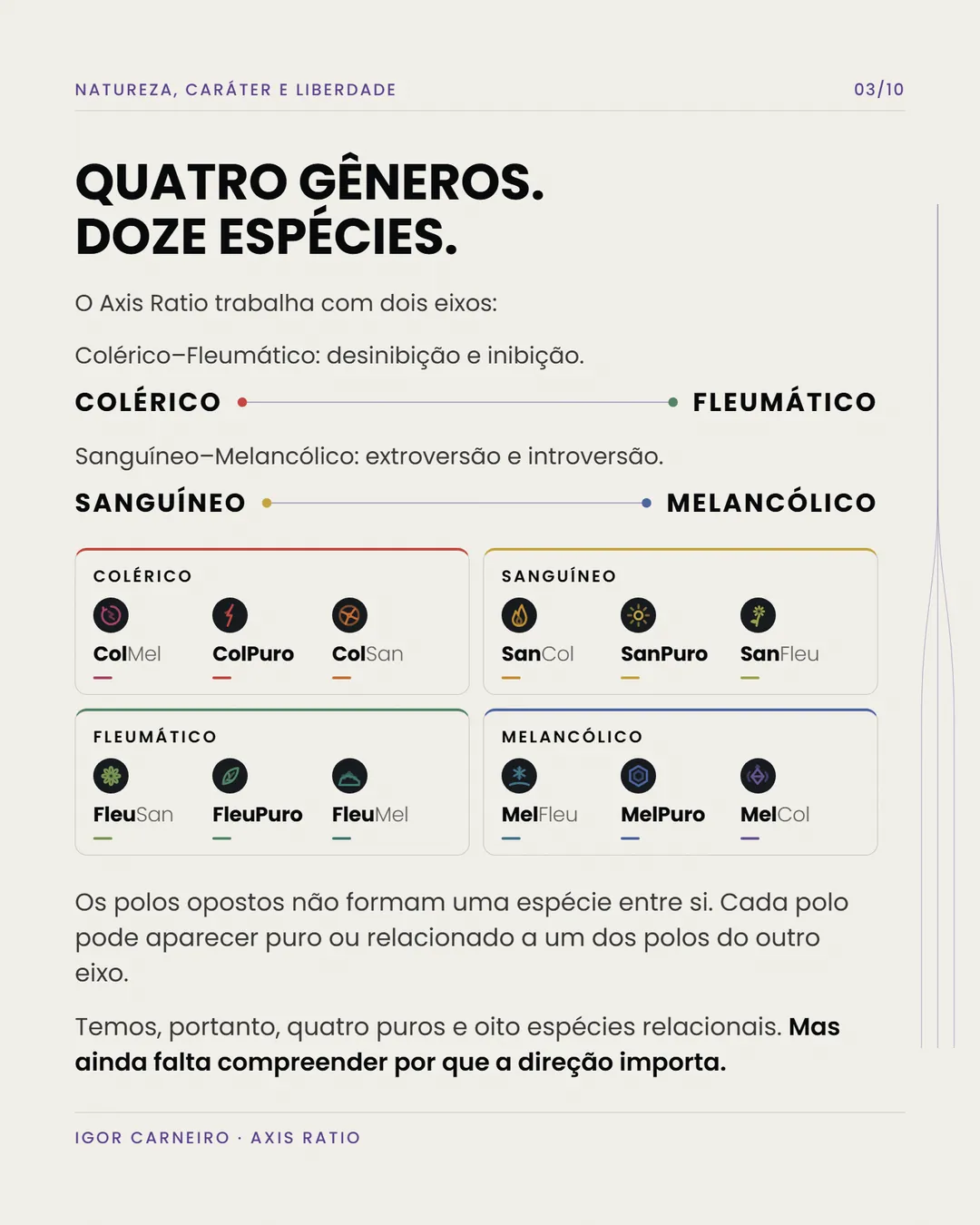
Four genera. Twelve species.
Axis Ratio works with two axes:
CHOLERIC PHLEGMATIC
SANGUINE MELANCHOLIC
Choleric
Sanguine
Phlegmatic
Melancholic
Opposite poles do not form a species with each other. Each pole can appear pure or related to one of the poles of the other axis.
So we have four pure types and eight relational species. But we still need to understand why the direction matters.
 04
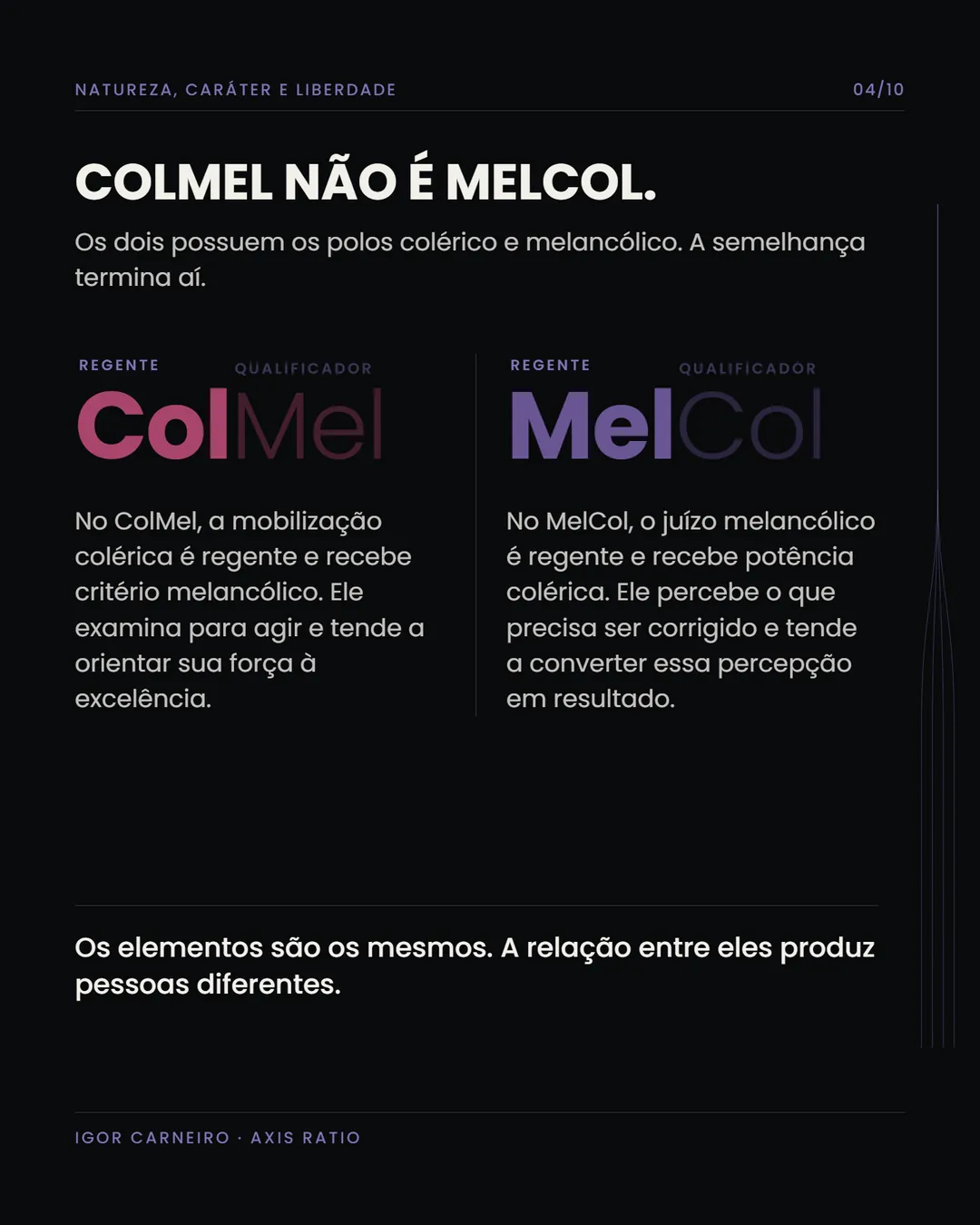
ColMel is not MelCol.
Both have the choleric and the melancholic poles. The resemblance ends there.
GOVERNING Col
QUALIFIER Mel
In the ColMel, choleric mobilization governs and receives melancholic criterion. He examines in order to act and tends to direct his strength toward excellence.
GOVERNING Mel
QUALIFIER Col
In the MelCol, melancholic judgment governs and receives choleric power. He perceives what needs to be corrected and tends to turn that perception into results.
The elements are the same. The relationship between them produces different people.
 05
Not every choleric enters the battle the same way.
CHOLERIC GENUS
examines before mobilizing. He doesn't look for just any victory, but for the one that matches his criterion of excellence.
responds more directly to the obstacle, the challenge, and the chance to advance. Action finds its fuel in the confrontation itself.
mobilizes through people. His strength gains expression, communication, and the ability to rally others.
All of them belong to the choleric genus. None of them is merely “strong and explosive.”
 06
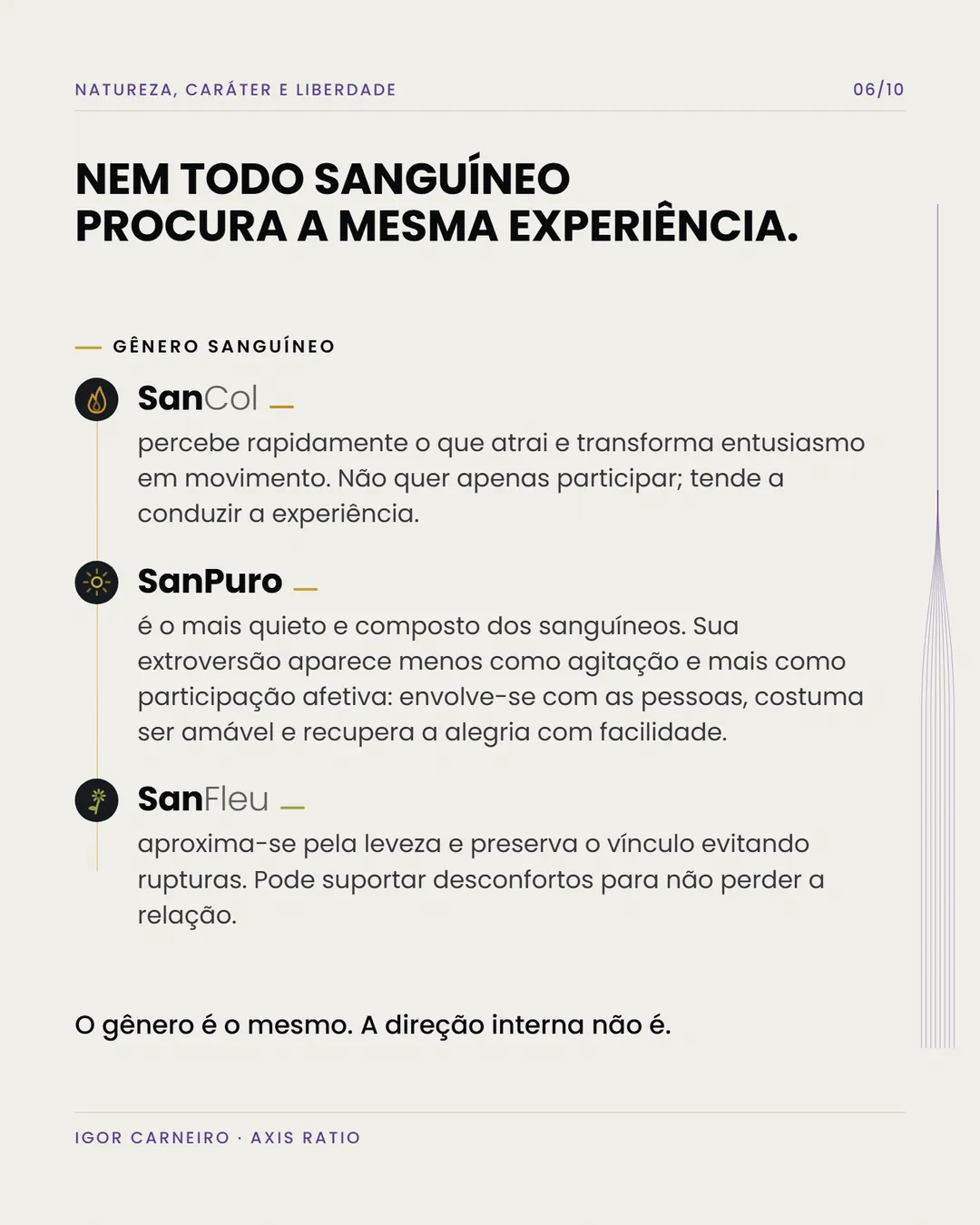
Not every sanguine seeks the same experience.
SANGUINE GENUS
quickly perceives what attracts and turns enthusiasm into movement. He doesn't just want to take part; he tends to lead the experience.
is the quietest and most composed of the sanguines. His extroversion shows less as agitation and more as affective participation: he gets involved with people, is usually kind, and easily recovers his cheerfulness.
draws near through lightness and preserves the bond by avoiding ruptures. He can put up with discomfort so as not to lose the relationship.
The genus is the same. The inner direction is not.
 07
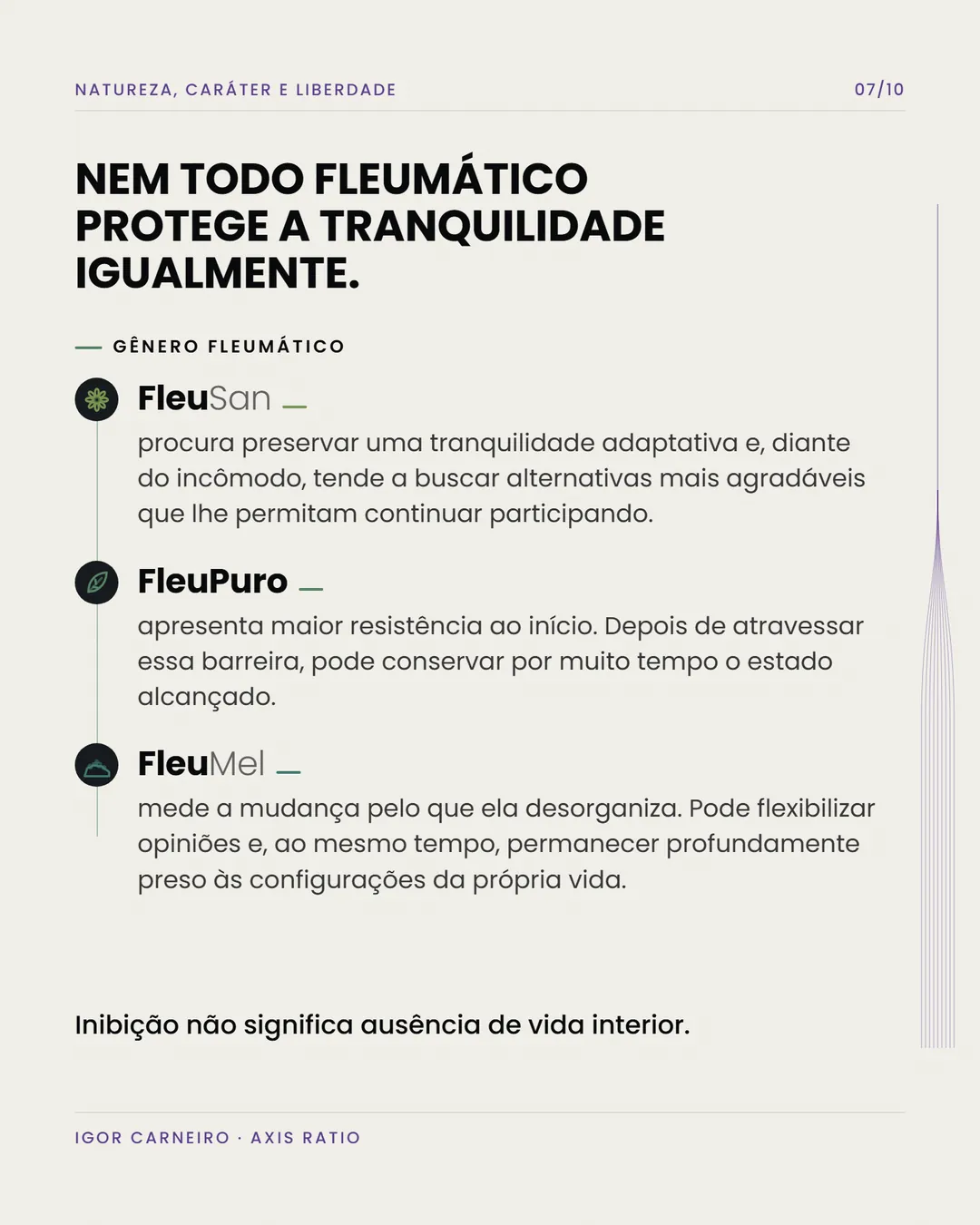
Not every phlegmatic protects tranquility in the same way.
PHLEGMATIC GENUS
seeks to preserve an adaptive tranquility and, when faced with discomfort, tends to look for more pleasant alternatives that let him keep taking part.
shows greater resistance to getting started. Once he gets past that barrier, he can hold on to the state he has reached for a long time.
measures change by what it disrupts. He can be flexible in his opinions and, at the same time, remain deeply attached to the arrangements of his own life.
Inhibition does not mean an absence of inner life.
 08
Not every melancholic perceives what is missing from the same place.
MELANCHOLIC GENUS
examines, preserves, and takes longer to let go of a conclusion. The second pole increases his resistance to change.
perceives limits, absences, and inconsistencies with great clarity. His seriousness is not necessarily sadness or bad temper.
identifies what doesn't work and tends to look for a practical fix. His discerning eye receives the strength to intervene in reality.
Introversion is not shyness. And a sense of reality is not pessimism.
 09
Twelve temperaments are not twelve characters.
Two people can seem entirely different. One may have acquired self-mastery; the other still reacts to any contradiction. One may be sociable; the other, reserved.
Temperament is not a ready-made personality.
It is a natural capacity that takes part in the way a person perceives and responds to reality. History, habits, upbringing, and character show what they have done with that capacity.
The type explains the structure. It does not write the biography on its own.
 10
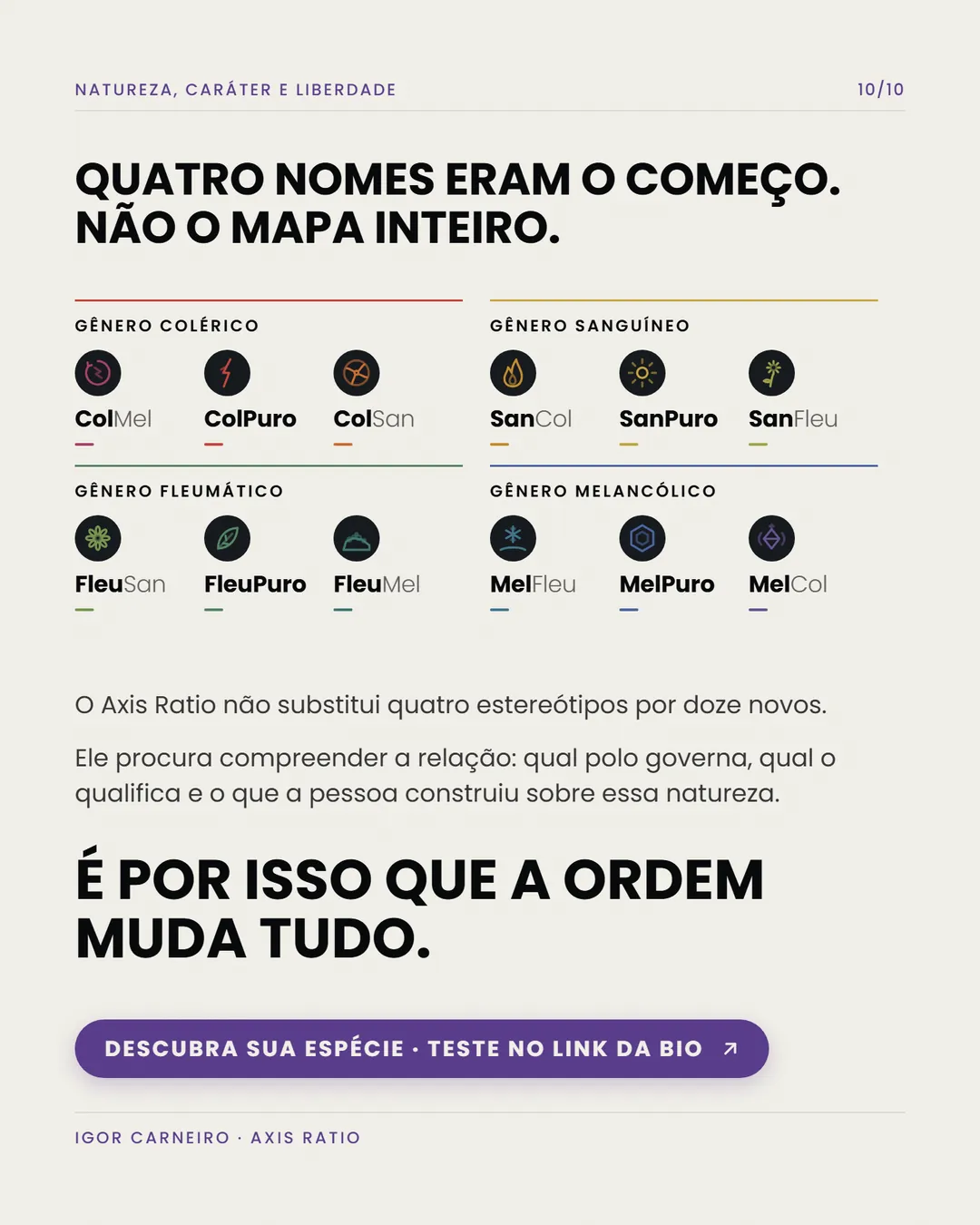
Four names were the beginning. Not the whole map.
Choleric genus
Sanguine genus
Phlegmatic genus
Melancholic genus
Axis Ratio does not replace four stereotypes with twelve new ones.
It seeks to understand the relationship: which pole governs, which one qualifies it, and what the person has built on top of that nature.
That is why the order changes everything.
DISCOVER YOUR SPECIES · TAKE THE TEST AT THE LINK IN BIO