
The same vice has different paths
Why knowing your temperament helps you put your life in order.

 02
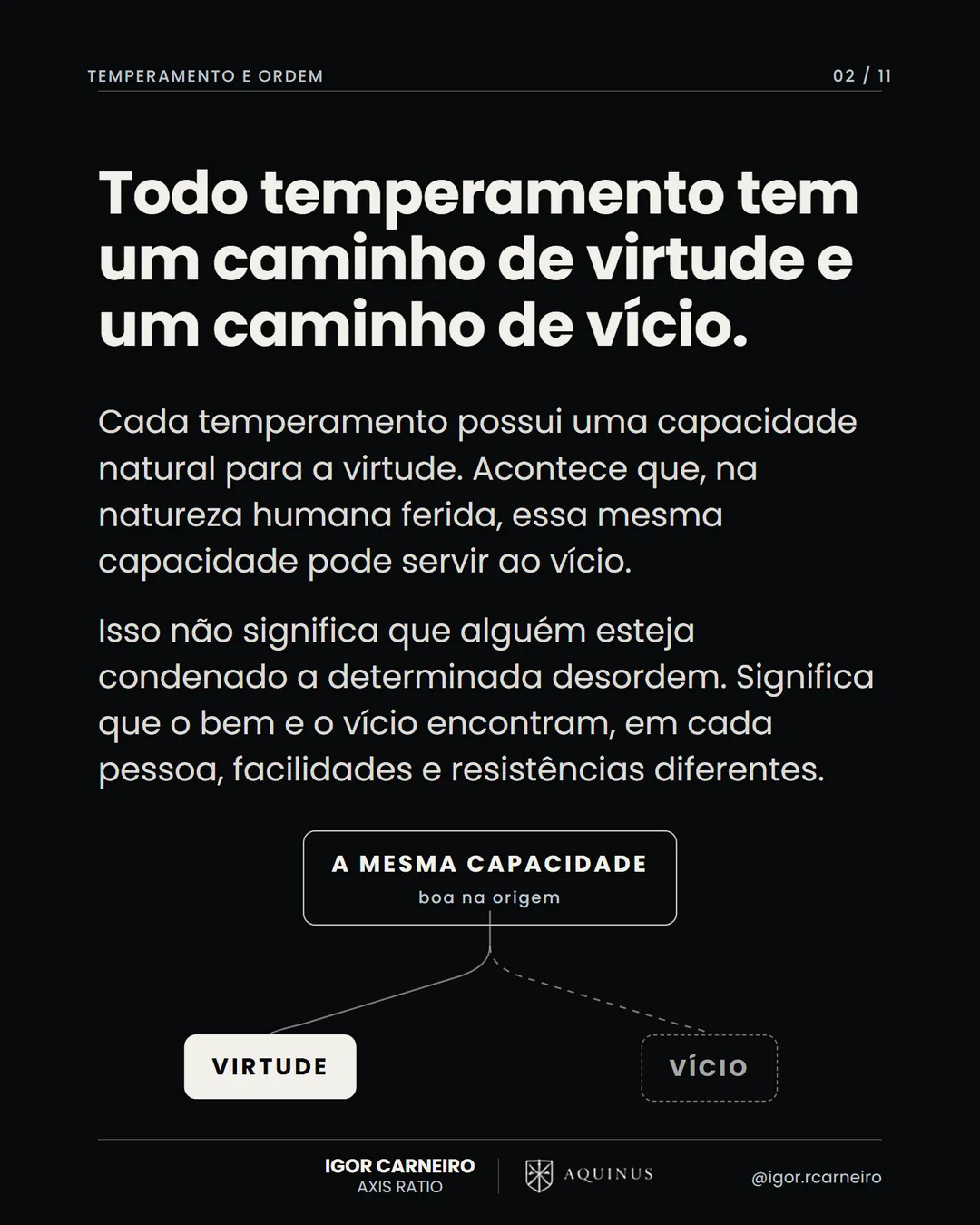
Every temperament has a path of virtue and a path of vice.
Each temperament has a natural capacity for virtue. The thing is, in wounded human nature, that same capacity can serve vice.
This doesn't mean anyone is condemned to a particular disorder. It means that good and vice meet, in each person, different ease and different resistance.
THE SAME CAPACITY: good at its origin
VIRTUE
VICE
 03
The act may be the same. The inner path may not be.
All vices can exist in all temperaments.
However, the way each one shows itself, its specific root, the justification by which it stays, and the effort needed to overcome it, all of this changes according to temperament.
 04
Everyone lies. Not everyone for the same reason.
FOR EXAMPLE: LYING
CONSEQUENCE CONTROL AFFECTION BEING RIGHT
Some people lie to avoid a consequence. Others lie to keep control, so as not to lose affection, or to preserve the image that they were right.
The lie doesn't change its nature. What changes is the apparent good each person is trying to protect and the path by which the lie becomes justifiable.
 05
The same act can promise different things.
ANOTHER EXAMPLE: PORNOGRAPHY
RELIEF DOMINANCE COMPENSATION BEING DESIRED
With pornography, these are some of the motives that can lead someone to it: relief, a sense of dominance, compensation, pleasure, or the feeling of being desired.
These examples don't form a table of types. The same person can combine more than one driver, and no single act reveals their temperament.
 06
Stopping the behavior is not the same as putting your life in order.
Interrupting the act is necessary, but order doesn't end there. You have to discover what it promises: control, relief, approval, escape, or compensation.
When that promise remains intact, a person can give up one act and seek the same disorder by another path.
 07
Virtue meets different kinds of resistance.
Each temperament faces an effort of its own.
THE CHOLERIC: needs to remain in the good even when he cannot win;
THE SANGUINE, to remain in the good without pleasure or approval;
THE PHLEGMATIC, to mobilize himself despite disturbance;
THE MELANCHOLIC, to submit his measure to the truth when it goes against him.
In the Axis Ratio method, the four genera combine into twelve species. Each combination meets its own test.
 08
Understanding why you fall is only the beginning.
That understanding needs to become practice: concrete limits, opposite habits, repairing relationships, and tolerance for frustration. This healing process is much more effective with therapeutic support. And, sustaining it all, the sacramental life.
Order isn't born just from understanding why one fell, but from repeating the good until another way of life takes hold.
 09
Putting things in order doesn't mean destroying your temperament.
The capacity remains. What changes is what it serves.
PURE CHOLERIC: force that only wants to win → power that accepts limits
CHOLERIC-SANGUINE: being the center → leading by fostering autonomy
CHOLERIC-MELANCHOLIC: excellence as credit → excellence as duty
PURE SANGUINE: joy that asks for applause → joy without dependence
SANGUINE-CHOLERIC: inflated image → confidence in the truth about oneself
SANGUINE-PHLEGMATIC: adapting until dissolving → belonging without losing what is essential
PURE PHLEGMATIC: calm that avoids → stability that knows how to move
PHLEGMATIC-SANGUINE: absolute tranquility → peace subordinated to the good
PHLEGMATIC-MELANCHOLIC: fidelity to form → fidelity to value
PURE MELANCHOLIC: measure in the service of the self → a strong, correctable yardstick
MELANCHOLIC-PHLEGMATIC: holding on to one's own conclusion → firmness that accepts correction
MELANCHOLIC-CHOLERIC: one's own worth as an entitlement → achievement without a claim to the result
Not everyone goes through the crossed-out form; some already grow up in the ordered one.
 10
TEMPERAMENT DOESN'T CHANGE THE GOOD.
TO KEEP IN MIND
It changes the point at which the good will demand more of you.
Knowing your temperament doesn't lessen your responsibility. It shows where order needs to begin.
 11
Do you know someone trying to put their life in order?
Send this post to that person. It may be the starting point they were missing.
I analyze temperament and character through the Axis Ratio method; Edilson Bueno shows how this becomes habit and concrete care. Follow @igor.rcarneiro and @edbueno1 for the next conversations.