
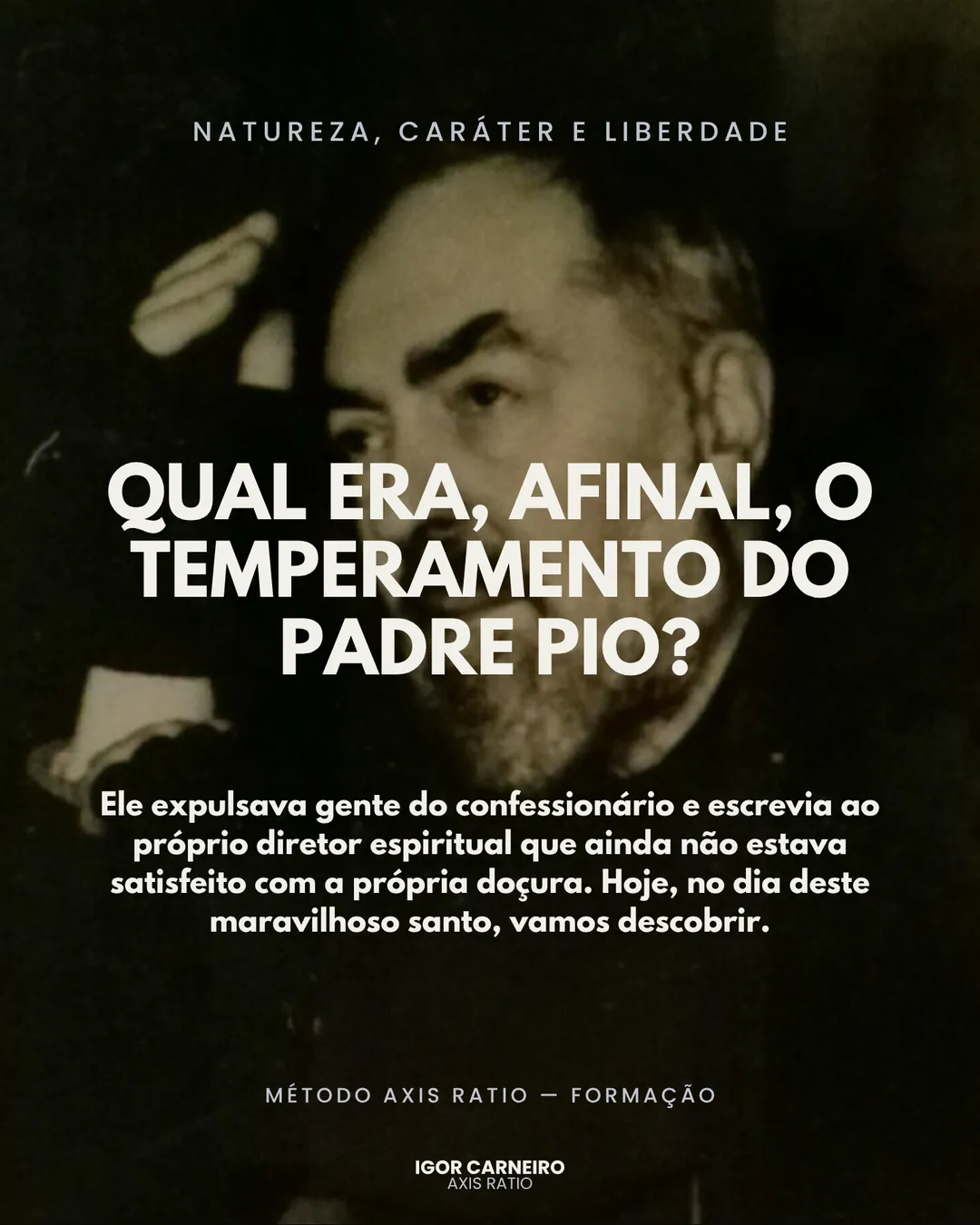
What was Saint Padre Pio's temperament?
He threw people out of the confessional and wrote to his own spiritual director that he was still not satisfied with his own gentleness. Today, on this wonderful saint's feast day, let's find out.
 02
The image everyone knows
Padre Pio became known for his severity. There are numerous accounts of penitents treated with enormous harshness and, on certain occasions, sent away from the confessional. He could raise his voice, answer brusquely and react strongly to what he considered serious. In one of the films about him, the “Chi sei?!” scene, when someone came to him with gossip about the bishop, is quite memorable.
So it would be very easy to look at these episodes and conclude: “he was choleric.”
But that is precisely the kind of analysis I try to avoid.
An isolated behavior can spring from very different causes. To understand a temperament, you have to discover what remains across different situations — including when the person is fighting against their own natural ease. What was his driving force?
 03
Padre Pio knew he was impatient
The most interesting piece of evidence does not come from those who were frightened by him. It comes from him.
In his letters of spiritual direction, Padre Pio acknowledges that, in certain situations, he ended up falling into acts of impatience “without my wanting it” and that he sometimes raised his voice precisely when he needed to correct someone.
That should be the tone of the reading: that impatience and that raised voice were not deliberate; they were something he himself thought he should avoid.
In other words, he did not present his harshness as a spiritual quality that others simply had to put up with. He saw in it something that needed to be governed, and he worked consciously to correct it.
Epistolario I, pp. 883 and 1170
 04
The penance was to become gentler
His spiritual director did not tell him to stop being firm. He told him to train the way that firmness came out.
Whenever he lost his restraint, he was to impose on himself a very concrete penance: to become, at once, twice as gentle.
Padre Pio took this seriously. Some time later, he wrote to his director that “Madam Gentleness” seemed to be doing better, but he added an even more revealing sentence:
“Nor am I satisfied.”
Having improved was not enough. He kept comparing what he was with what he understood he ought to be.
From this we can see Padre Pio's holiness not in the perfection of his acts, but in the obedience and the great love with which he wanted to become a better person.
Epistolario I, pp. 1172 and 1244
 05
And he was not a scowling man
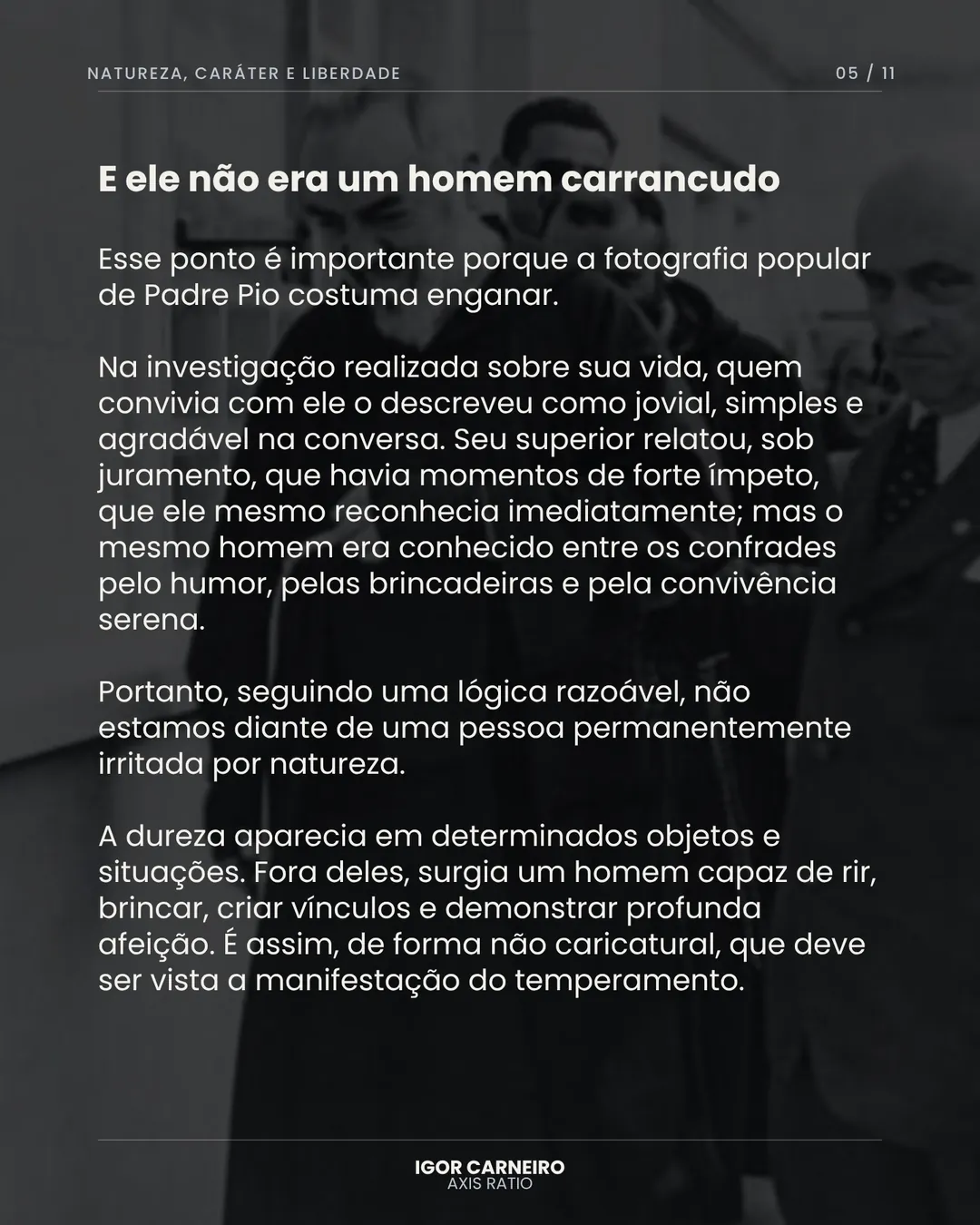
This point matters because the popular picture of Padre Pio tends to mislead.
In the investigation conducted into his life, those who lived with him described him as jovial, simple and pleasant in conversation. His superior reported, under oath, that there were moments of strong impulse, which he himself immediately acknowledged; but the same man was known among his brothers for his humor, his jokes and his serene companionship.
So, following a reasonable logic, we are not dealing with a person who was permanently irritable by nature.
The harshness appeared with certain objects and in certain situations. Outside them, there emerged a man capable of laughing, joking, forming bonds and showing deep affection. That is how the manifestation of temperament should be seen: without caricature.
 06
This is more interesting than anger
If I looked only at the outbursts, I would have a trait. When I look at the whole, something more complex appears: an enormous capacity to confront, to intervene and to sustain effort, accompanied by a very strong inner demand for correctness and measure.
A natural inclination toward excellence… which is the mark of a temperament.
There is, however, a decisive detail: this demand was not used only to judge others. Padre Pio subjected himself to the same standard. The sentence “nor am I satisfied” perhaps says more about his temperament than many of the famous confessional scenes, because it shows that the force with which he could correct others was also subjected to a standard of correction applied to himself.
Sometimes, for a Choleric-Melancholic, anger is a more natural response, preferable to sadness. Once, to a brother who reproached him for being brusque, he replied: “I act harsh so as not to dissolve into tears. My heart is troubled to see so much pain and not be able to console these people.”
Epistolario I, p. 1244 · Renzo Allegri, Padre Pio: um santo entre nós, p. 279
 07
My reading: choleric-melancholic
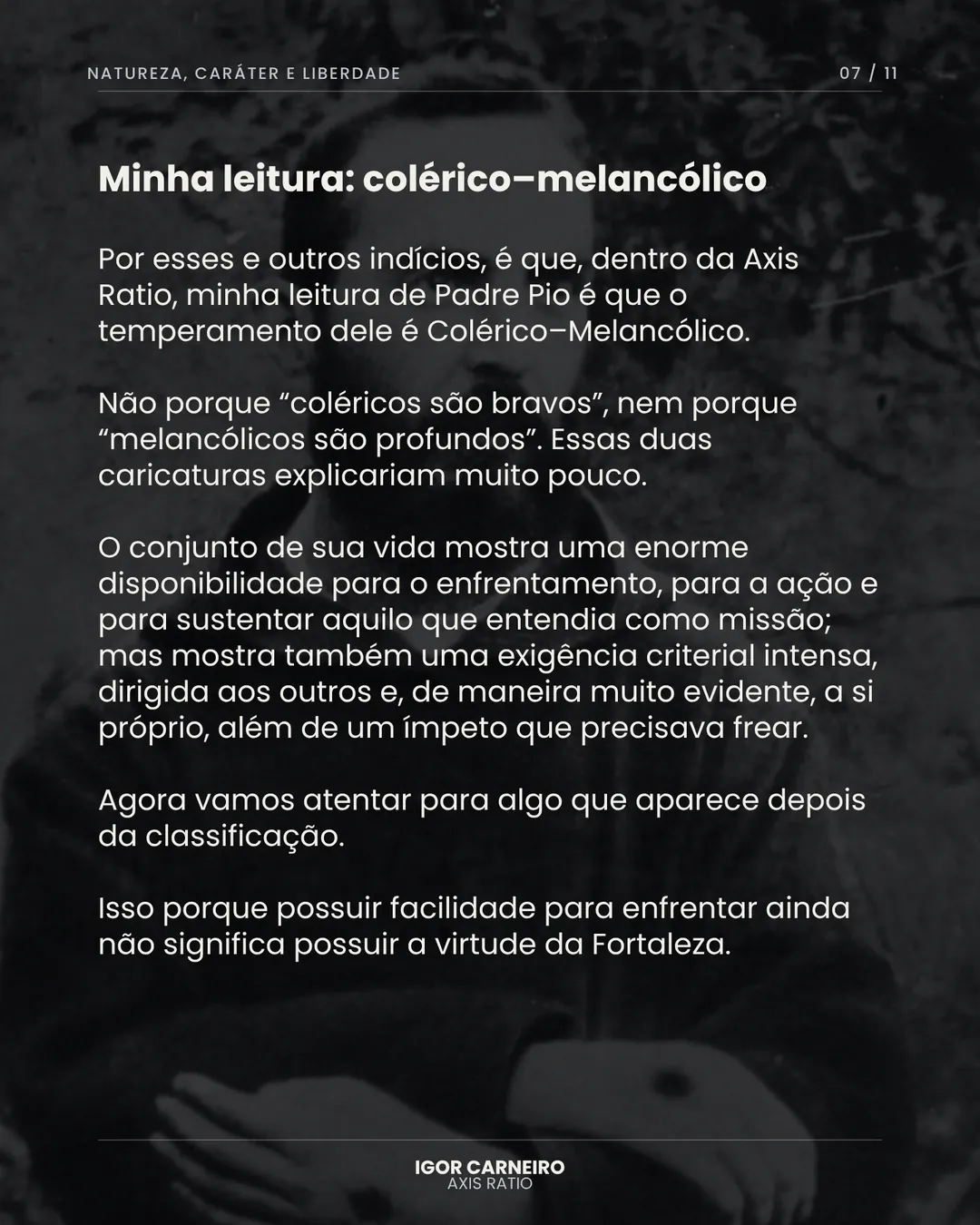
Because of these and other signs, within Axis Ratio, my reading of Padre Pio is that his temperament is Choleric-Melancholic.
Not because “cholerics are angry,” nor because “melancholics are deep.” Those two caricatures would explain very little.
The whole of his life shows an enormous readiness for confrontation, for action and for sustaining what he understood as his mission; but it also shows an intense demand for a standard, directed at others and, very evidently, at himself, along with an impulse he needed to rein in.
Now let's pay attention to something that appears after the classification.
Because having a natural ease for confrontation does not yet mean having the virtue of Fortitude.
 08
Attacking is easier than enduring
Saint Thomas makes a surprising distinction when he treats Fortitude.
The principal act of this virtue is not to attack but to endure: to stand firm when the evil cannot simply be removed by one's own action.
This changes the way you look at a naturally combative person.
It is relatively easy to mistake the capacity to enter a fight for Fortitude. The deeper test comes when someone who naturally wants to act meets a reality they cannot master, defeat or correct — and must remain in the good anyway.
What does this mean? That temperament is not the virtue itself, but a natural inclination. There are still many points that must be developed to truly have that virtue.
Summa Theologiae, II-II, q. 123, a. 6
 09
Padre Pio was placed in exactly that situation
When they took away his ability to exercise much of his ministry in public, Padre Pio did not receive the decision with indifference. It struck him deeply.
Yet, on hearing the order, he answered: “God's will be done.” Then he went back to prayer.
Some time later, his own confessor found him dejected; Padre Pio began to weep and spoke of the pain of that trial.
This sequence is far more important than an image of impassivity. He did not obey because he did not suffer.
He obeyed while suffering.
That is the stuff of a saint: a love so great, a desire to please God so great, that it goes as far as running against his own natural inclination.
 10
Holiness did not need to erase him
Here we are not dealing with the stigmata, the countless miracles and the extraordinary gifts of Padre Pio.
To analyze his temperament, I chose to look only at his strictly human side, apart from what was a clear manifestation of God's power, and not his own. And what I was able to see is that the impatient man did not become someone naturally indifferent; that the man capable of harshness did not lose his strength; and that the man who wanted to act did not stop feeling deeply when he was prevented from doing so.
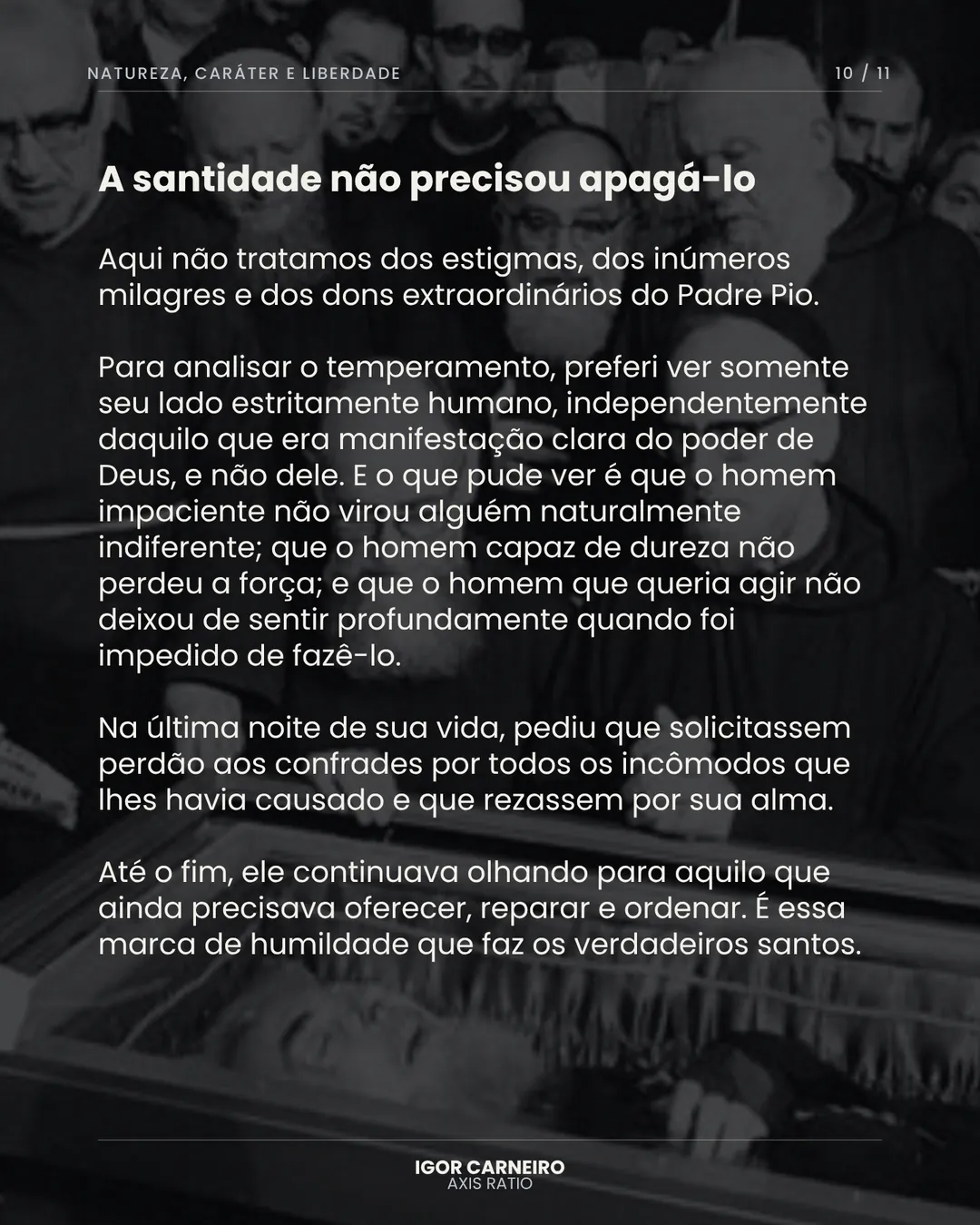
On the last night of his life, he asked that his brothers be begged for forgiveness for all the trouble he had caused them, and that they pray for his soul.
To the end, he kept looking at what he still needed to offer, to make amends for and to set in order. It is this mark of humility that makes true saints.
 11
Take Padre Pio to more people
Today is his feast day. If this reading helped you see the saint behind the reputation for severity, send this post to someone devoted to Padre Pio and save it to reread calmly.
Here I analyze the temperament of saints, historical figures and public figures by the Axis Ratio method. Follow @igor.rcarneiro to keep up with the next readings.
And tell me in the comments: which saint do you want to see analyzed?