
A Phlegmatic Temperament Is Not the Same as Laziness
But that's no excuse for not acting, either.

 02
Laziness?
"Did you do that yet?"
"I'm on it."
20 minutes later.
"So?"
"I'm on it."
1 hour later.
 03
Why do the two get confused?
You ask someone to do something. They know they need to do it, they agree they should do it, and even so, they take their time. "I'm on it." Twenty minutes go by, then an hour.
Whoever is watching from outside quickly concludes: laziness. Sometimes it may be. But the behavior, by itself, doesn't let us know.
Because two people can put off exactly the same task for completely different reasons, and one of them may find it much easier to keep working once they've finally started.
 04
The problem isn't always doing it
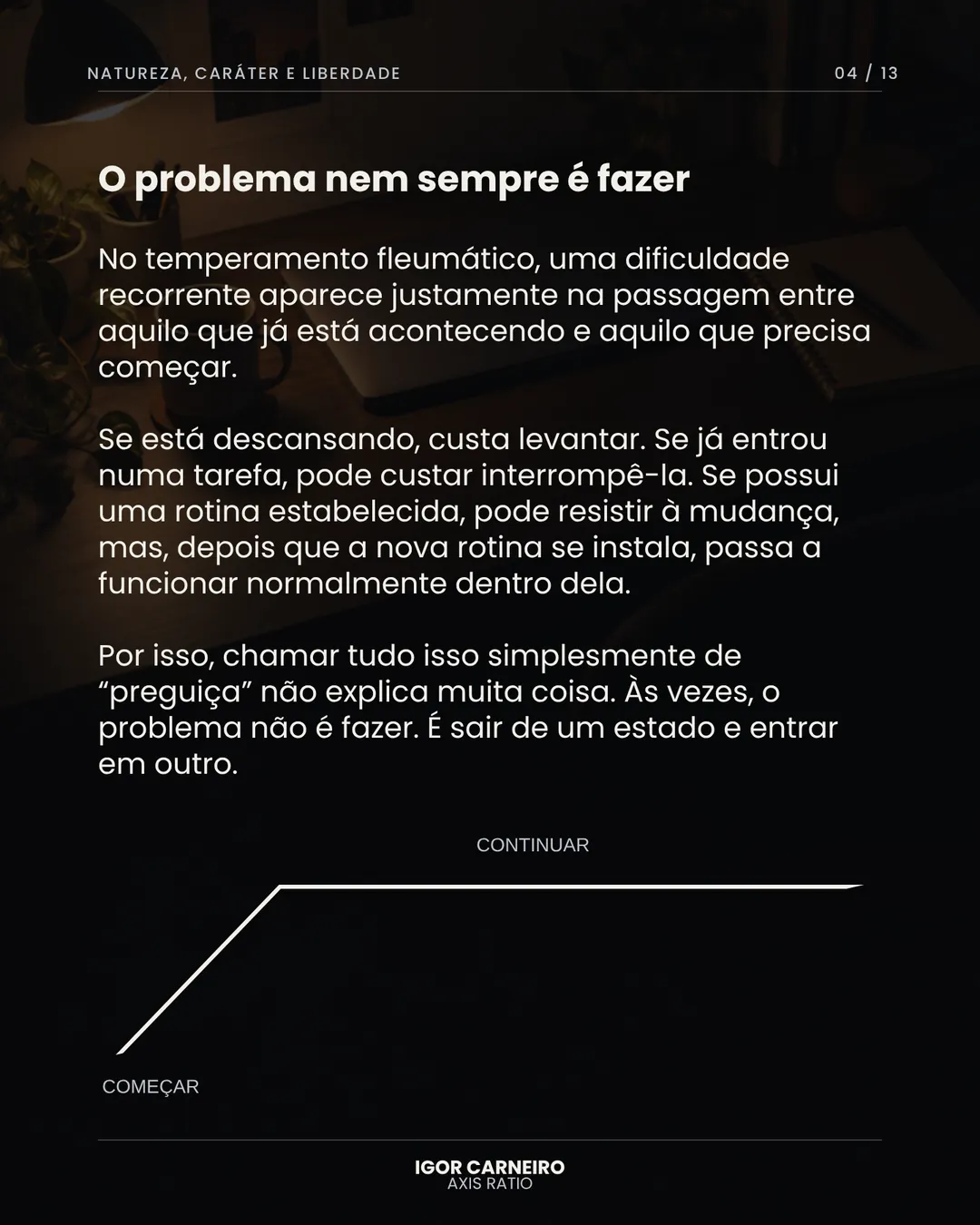
In the phlegmatic temperament, a recurring difficulty shows up precisely in the passage between what is already happening and what needs to begin.
If they're resting, it's hard to get up. If they've already gotten into a task, it can be hard to stop it. If they have an established routine, they may resist change, but once the new routine settles in, they function normally within it.
That's why simply calling all of this "laziness" doesn't explain much. Sometimes the problem isn't doing it. It's leaving one state and entering another.
 05
That's why he can seem contradictory
The same person who takes a long time to start a task can work for hours once they're into it. They can struggle to build a gym routine and, months later, get annoyed when something interrupts exactly that routine. They can put off a phone call for three days and, when they take on a role with defined hours and responsibilities, carry out everything regularly.
This only seems contradictory if the explanation is "he has little energy" or "he doesn't like to work."
Often, the hard point was in the change of state, not in the activity itself.
 06
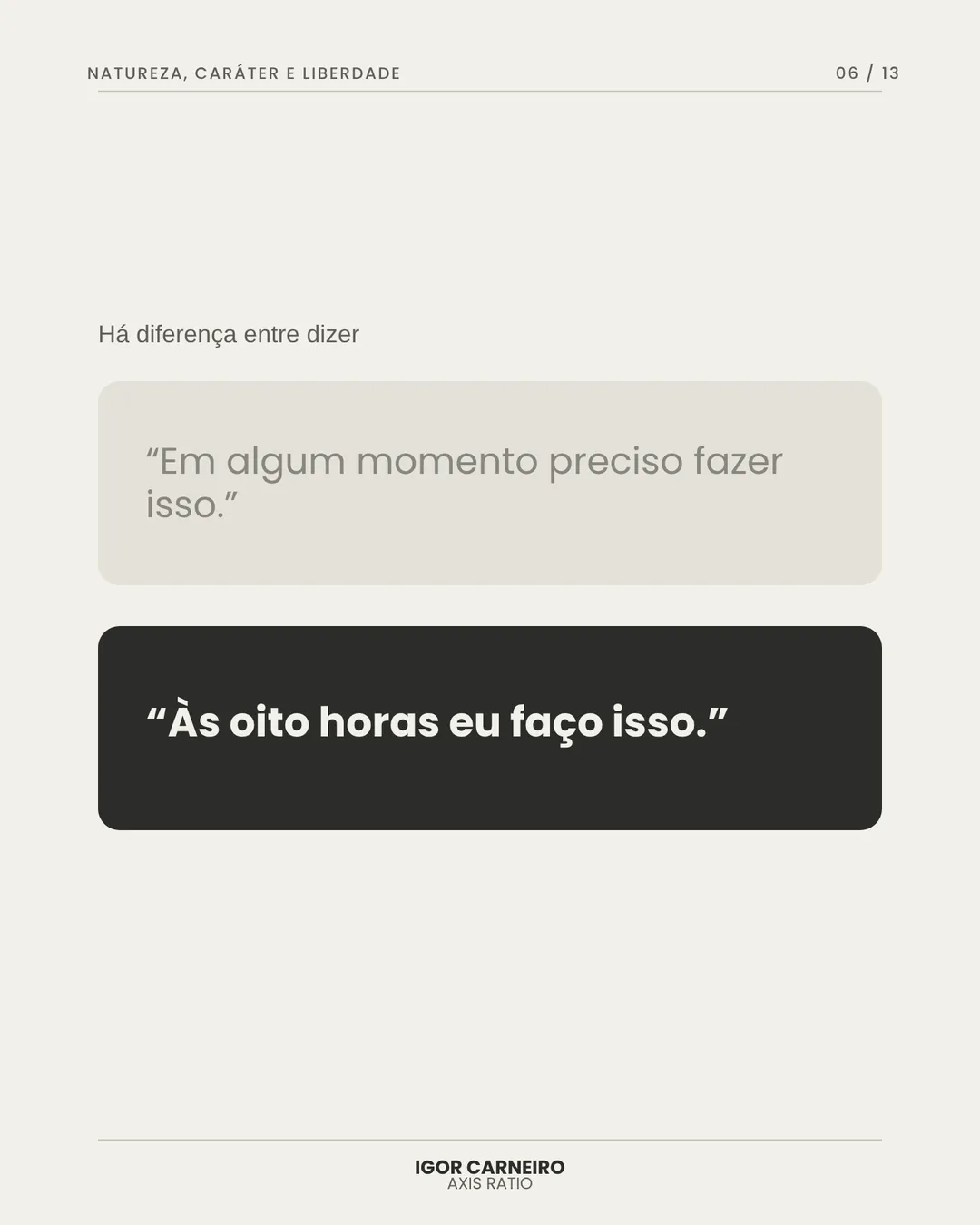
There's a difference between saying
"At some point I need to do this."
"At eight o'clock I'll do this."
 07
External structure makes a difference
That's why deadlines, schedules, commitments, and external responsibility can help a lot. When the sentence stops being "at some point I need to do this" and becomes "at eight o'clock I'll do this," part of the decision has already been settled in advance. The person doesn't need to keep re-creating the mobilization it takes to start.
That's also why someone who seems disorganized on their own can function very well within a clear professional structure.
It doesn't mean they need to be told what to do their whole life. It means structure can reduce the cost of starting.
 08
But here is where responsibility comes in
Understanding the difficulty doesn't mean turning temperament into a permission slip to stay still. There's an enormous difference between saying "now I understand why this costs me more" and saying "since that's how I am, I won't do it."
Temperament helps explain why certain situations demand more effort from some people. It doesn't decide what they should do in the face of them.
If I clearly recognize a duty, have a real possibility of fulfilling it, and keep postponing it indefinitely just so I won't be disturbed, it's no longer enough to say "that's just how I am."
 09
That's why calm isn't prudence either
The phlegmatic can seem prudent because he waits, observes, and doesn't rush. Sometimes that really helps.
But there comes a moment when thinking more no longer improves the decision. The answer is already clear and the only thing missing is to act. At that point, continuing to wait isn't prudence.
Maturity doesn't require the phlegmatic to start doing everything quickly or turn into an impulsive person. It only requires that the cost of starting stop deciding, on its own, what will be done.
 10
Having more difficulty getting moving is not the same as not wanting to act.
But the difficulty doesn't excuse you from duty either.
 11
So, what helps?
For many phlegmatic people, it works better to reduce the number of times they have to "start from scratch." Fixed schedules, routine, a commitment to another person, clear deadlines, and a first step defined ahead of time can work better than waiting for the will to show up.
Instead of "I need to get back to the gym," it can be much more effective to say "Monday, Wednesday, and Friday, at 6 p.m."
The idea isn't to build a life controlled by external obligations. It's to use structure until what was costly to start can become a habit.
 12
Temperament explains the cost. It doesn't decide the response.
Calling every phlegmatic lazy is a mistake because it confuses a natural difficulty with mobilization with a conclusion about their character. But using temperament to justify every omission would be making the opposite mistake.
Knowing your own temperament should increase your freedom, not diminish your responsibility. The question stops being only "why does this cost me so much?" and comes to include another: "knowing that it costs me, what do I need to do to act when it's necessary?"
 13
Know someone like this?
Send this post to someone who has been called lazy for being slow to start. And save it to look at again the next time you say "I'm on it."
Here I analyze temperament and character through the Axis Ratio method. Follow @igor.rcarneiro to keep up with the next readings.