
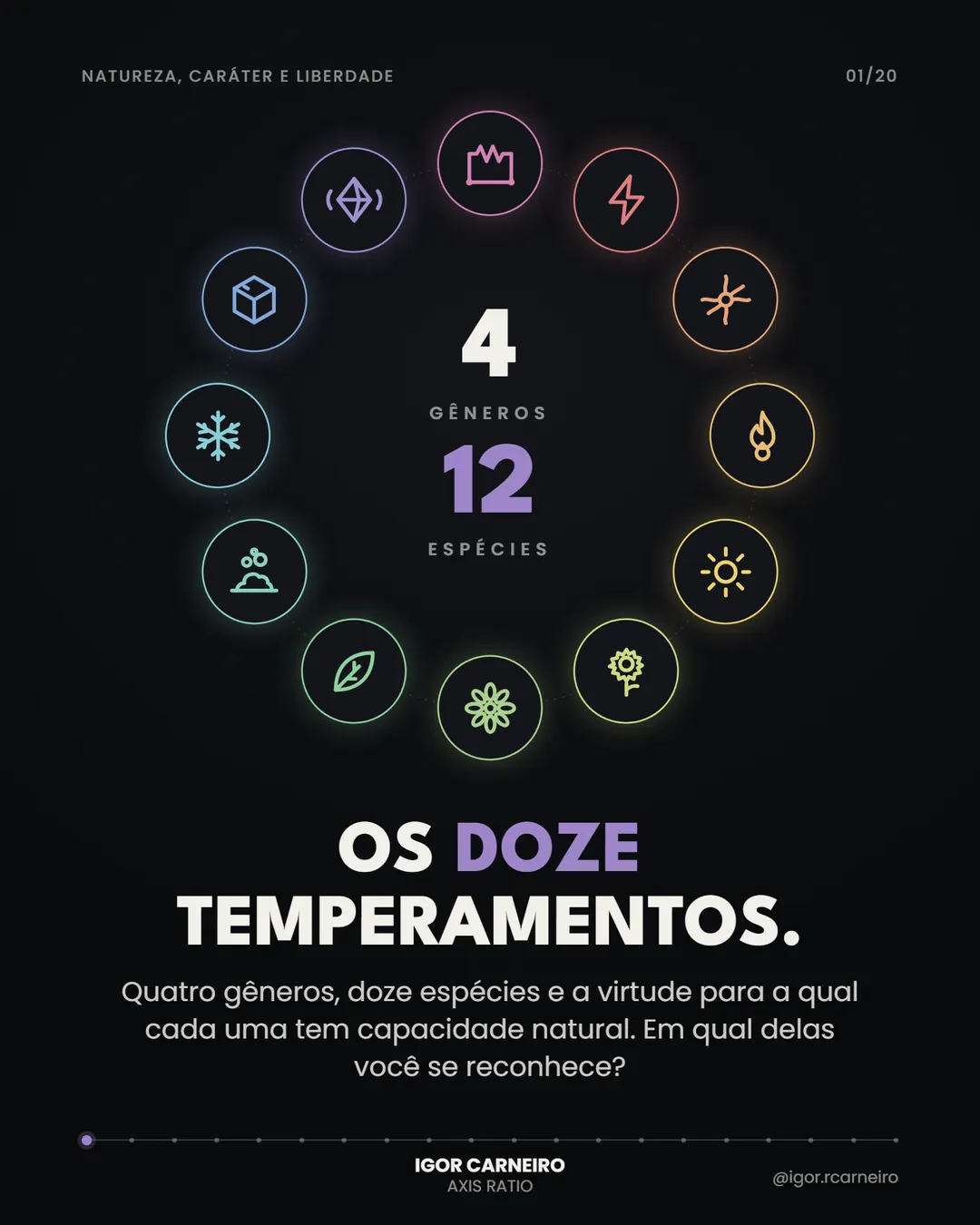
The twelve temperaments
Four genera, twelve species and the virtue for which each one has a natural capacity. In which of them do you recognize yourself?
 02
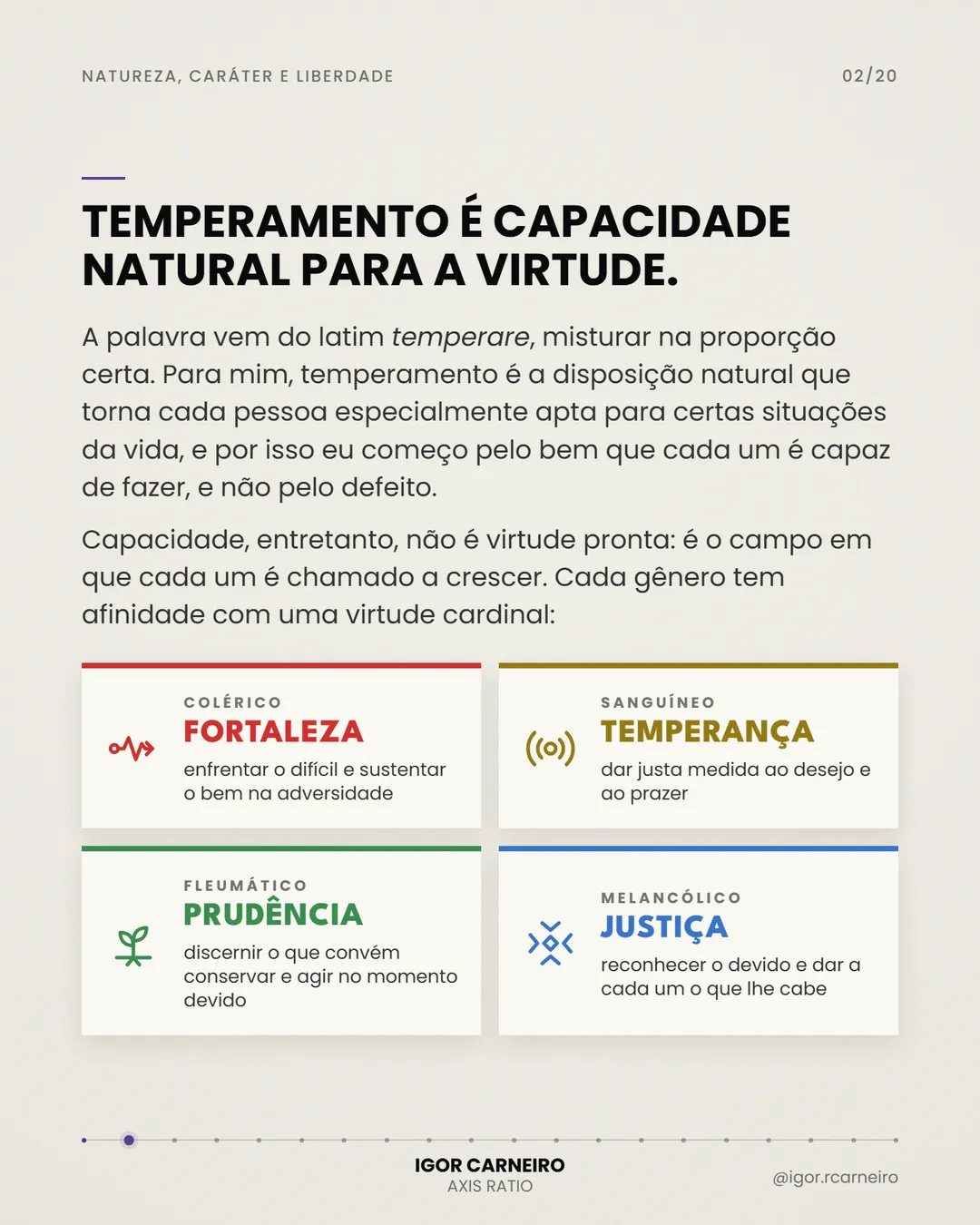
TEMPERAMENT IS A NATURAL CAPACITY FOR VIRTUE.
The word comes from the Latin temperare, to mix in the right proportion. For me, temperament is the natural disposition that makes each person especially fit for certain situations in life, and that is why I begin with the good each one is capable of doing, not with the defect.
Capacity, however, is not ready-made virtue: it is the field in which each one is called to grow. Each genus has an affinity with a cardinal virtue:
 03
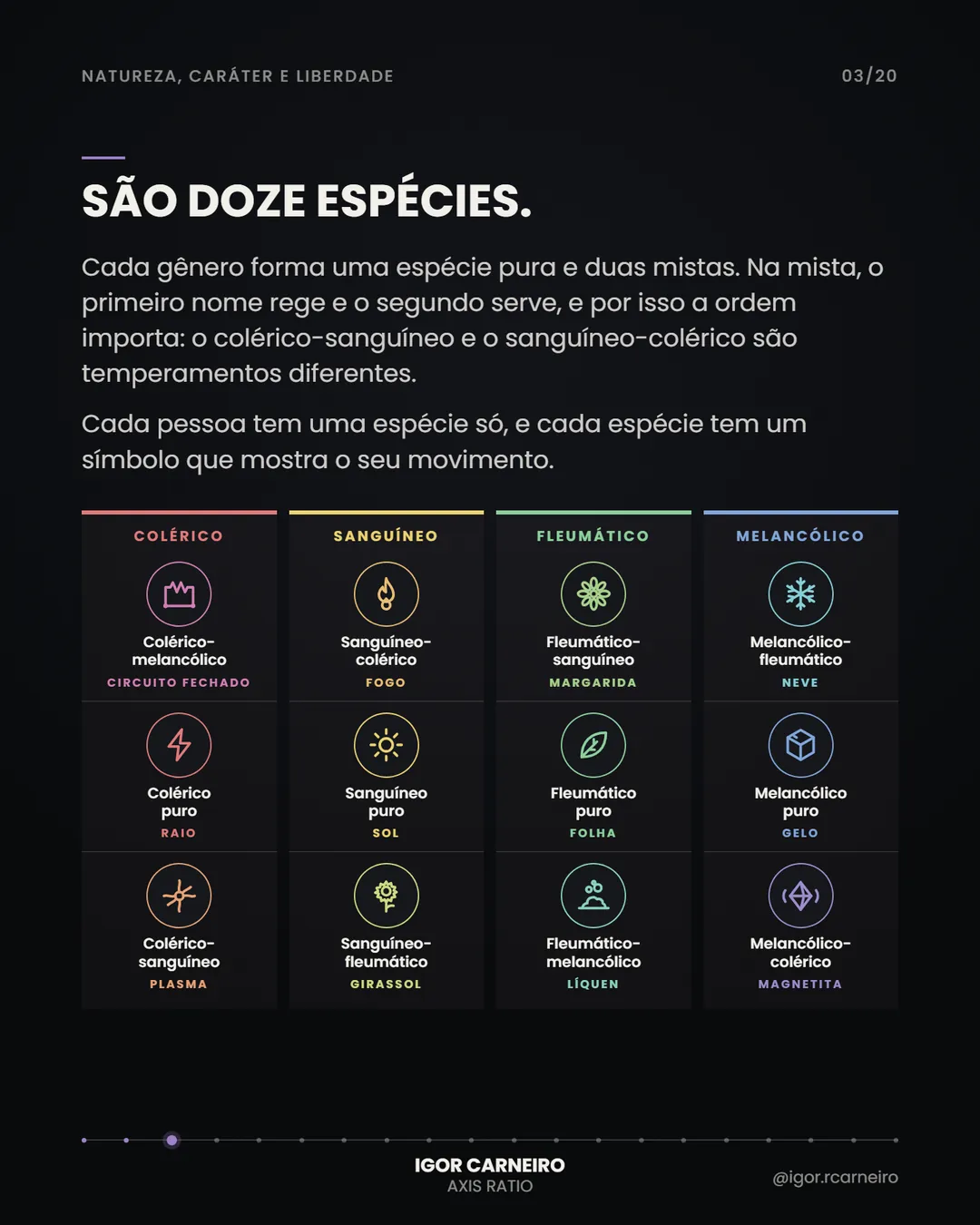
THERE ARE TWELVE SPECIES.
Each genus forms one pure species and two mixed ones. In a mixed species, the first name governs and the second serves, which is why the order matters: the choleric-sanguine and the sanguine-choleric are different temperaments.
Each person has only one species, and each species has a symbol that shows its movement.
 04
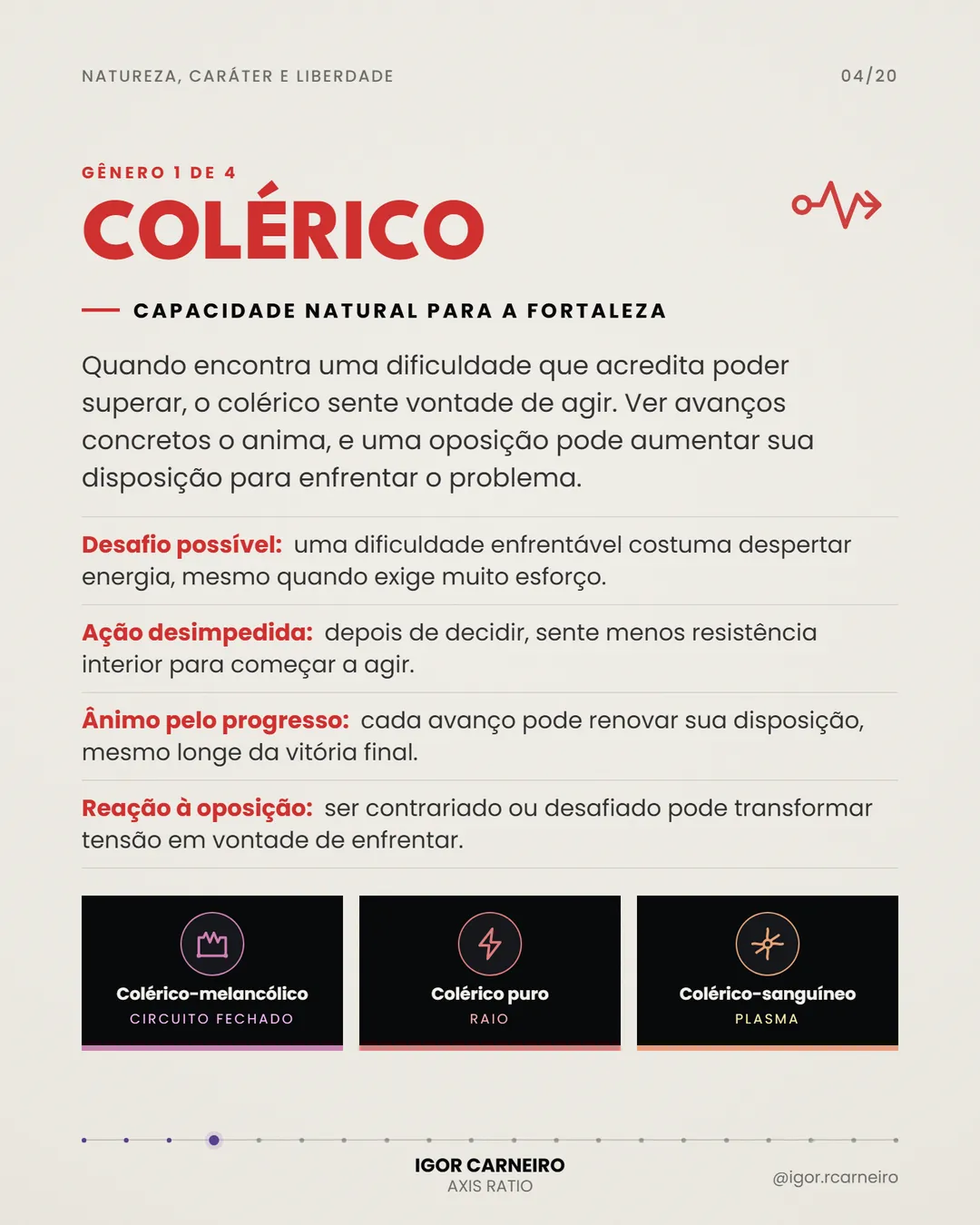
THE CHOLERIC.
When he meets a difficulty he believes he can overcome, the choleric feels the urge to act. Seeing concrete progress spurs him on, and opposition can increase his readiness to face the problem.
A possible challenge: a difficulty that can be faced tends to awaken energy, even when it demands a great deal of effort.
Unhindered action: once he has decided, he feels less inner resistance to starting to act.
Spurred by progress: each step forward can renew his drive, even far from the final victory.
Reaction to opposition: being contradicted or challenged can turn tension into the will to face things.
 05
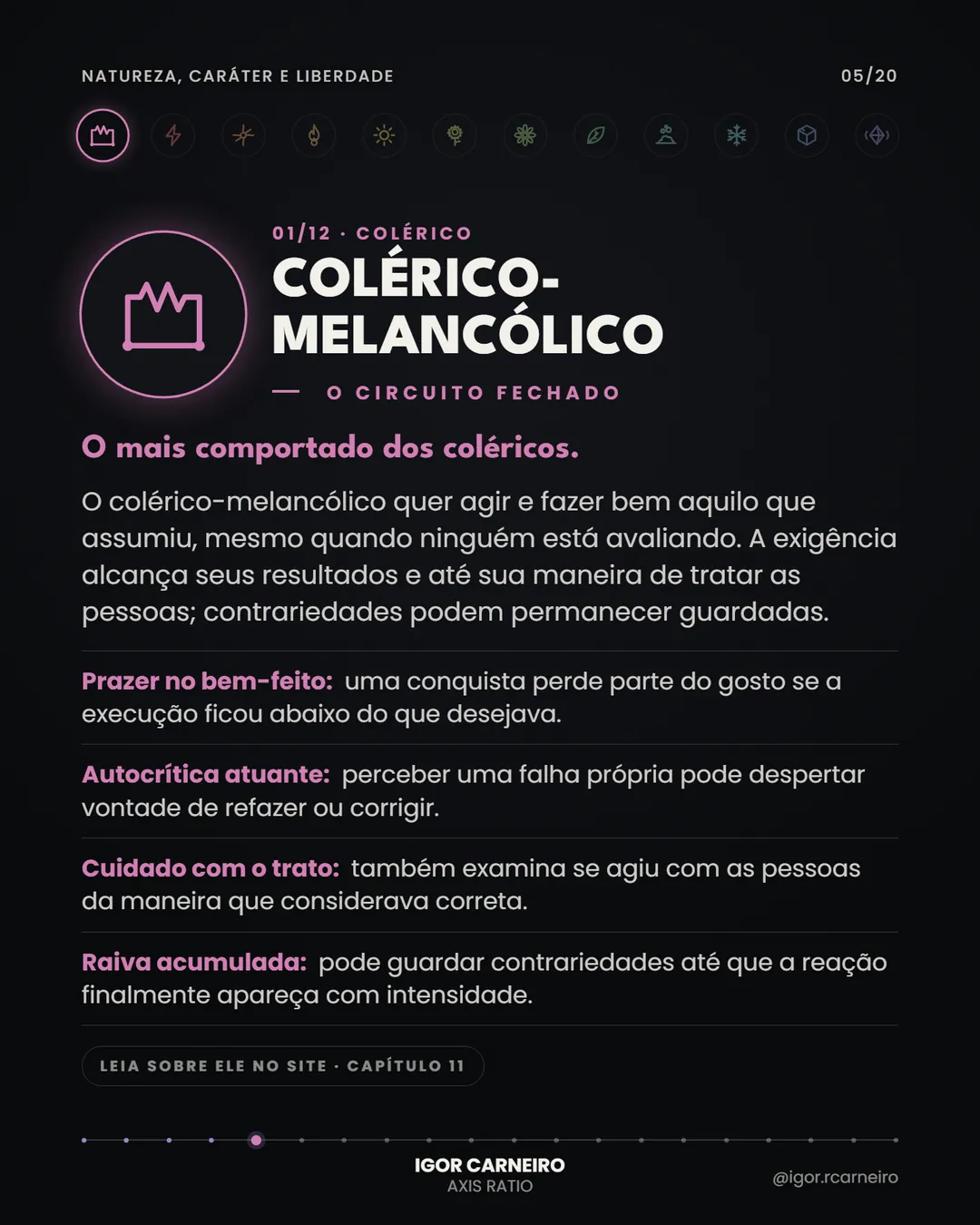
CHOLERIC-MELANCHOLIC.
The best-behaved of the cholerics.
The choleric-melancholic wants to act and to do well what he has taken on, even when no one is evaluating him. His demands reach his results and even the way he treats people; annoyances can stay stored up inside.
Pleasure in work well done: an achievement loses part of its taste if the execution fell short of what he wanted.
Active self-criticism: noticing a failing of his own can awaken the urge to redo or correct it.
Care in how he treats others: he also examines whether he acted toward people the way he considered right.
Built-up anger: he can store up annoyances until the reaction finally comes out with intensity.
 06
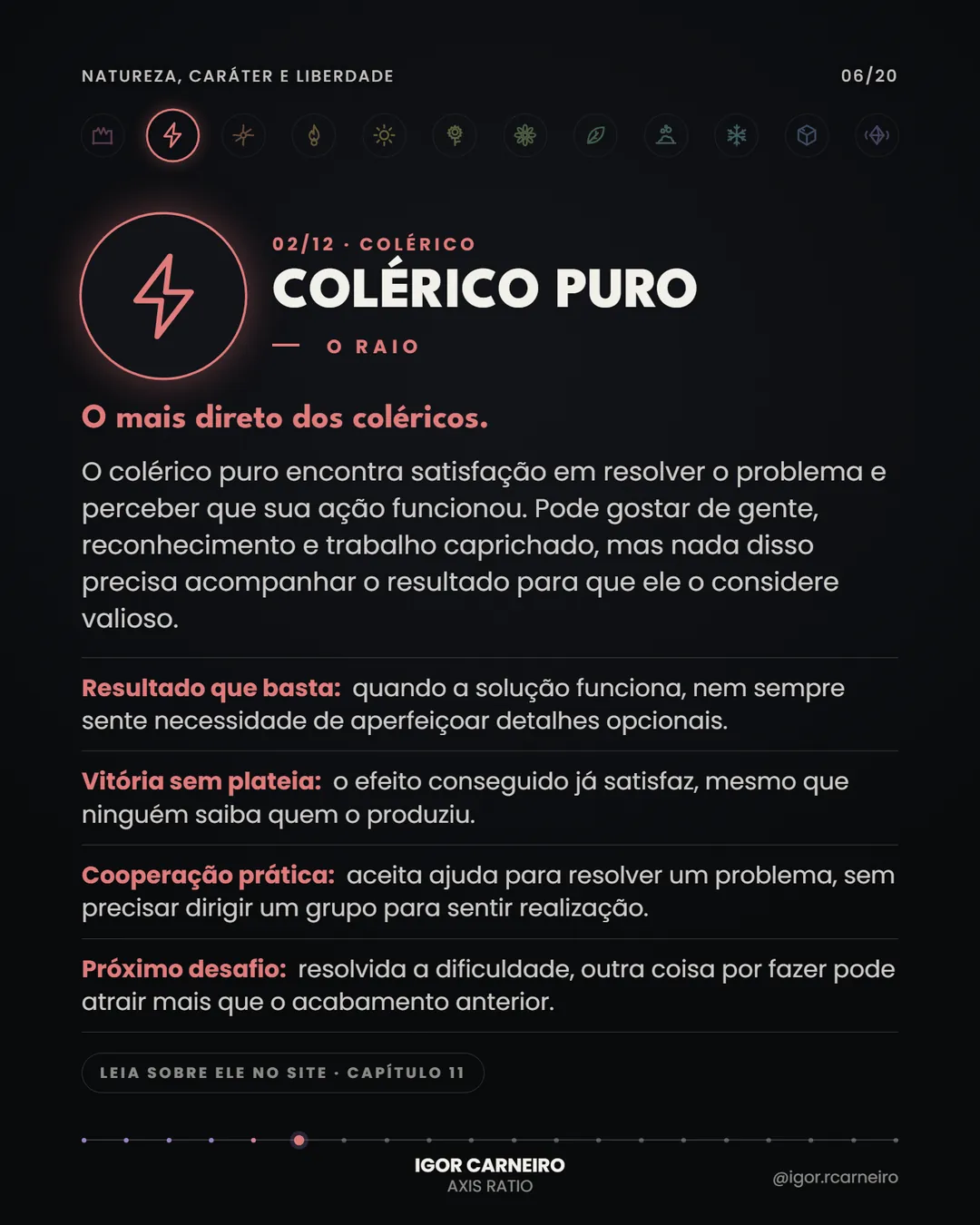
PURE CHOLERIC.
The most direct of the cholerics.
The pure choleric finds satisfaction in solving the problem and seeing that his action worked. He may like people, recognition and careful work, but none of that needs to come with the result for him to consider it valuable.
A result that is enough: when the solution works, he does not always feel the need to perfect optional details.
Victory without an audience: the effect achieved already satisfies him, even if no one knows who produced it.
Practical cooperation: he accepts help to solve a problem, without needing to lead a group to feel fulfilled.
The next challenge: once the difficulty is solved, something else to do can attract him more than finishing touches on the last thing.
 07
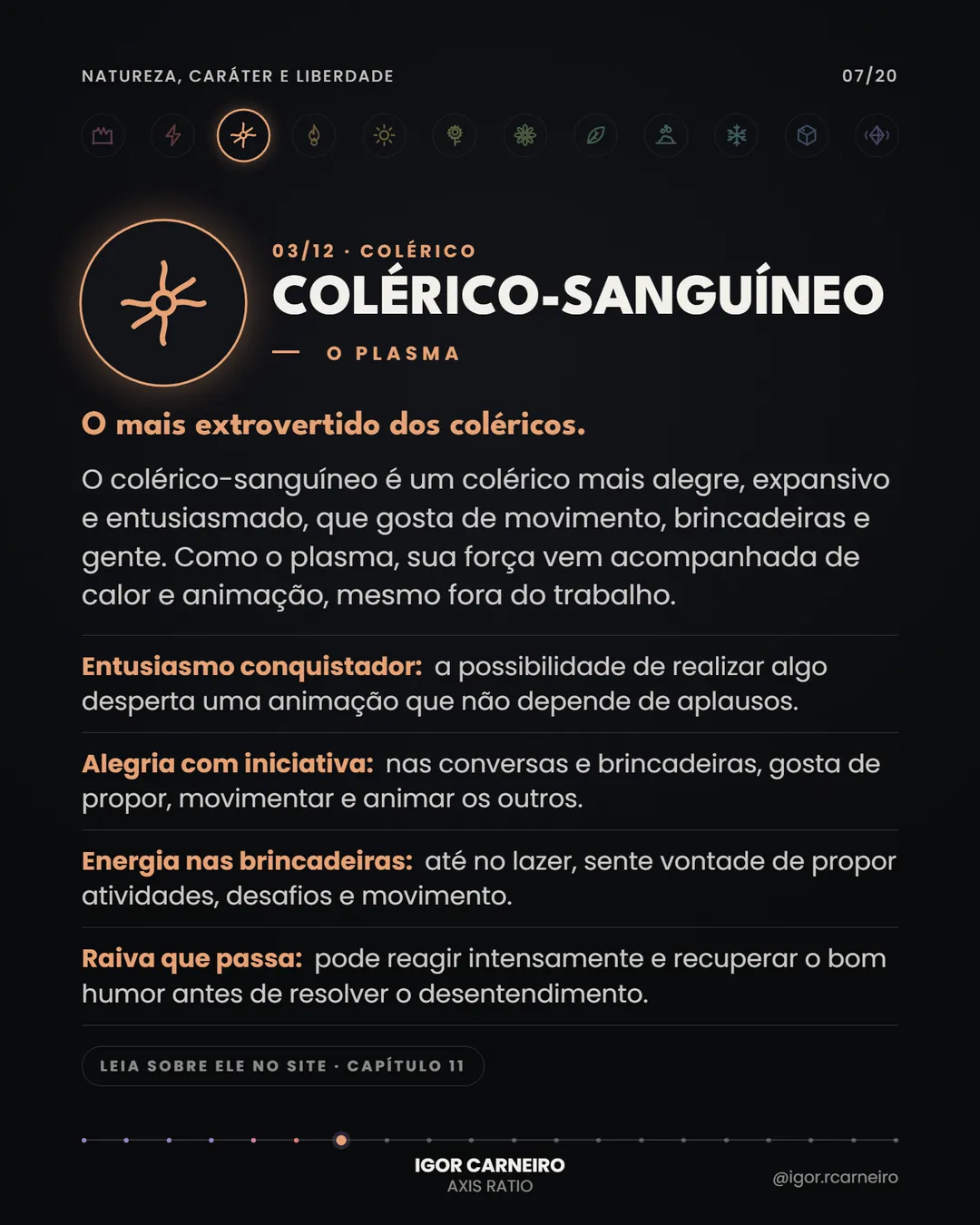
CHOLERIC-SANGUINE.
The most extroverted of the cholerics.
The choleric-sanguine is a more cheerful, expansive and enthusiastic choleric, who likes movement, joking around and people. Like plasma, his strength comes with warmth and liveliness, even outside of work.
Conquering enthusiasm: the possibility of accomplishing something awakens an excitement that does not depend on applause.
Joy with initiative: in conversations and fun, he likes to propose, get things moving and liven others up.
Energy at play: even in leisure, he feels like proposing activities, challenges and movement.
Anger that passes: he can react intensely and recover his good mood before the disagreement is resolved.
 08
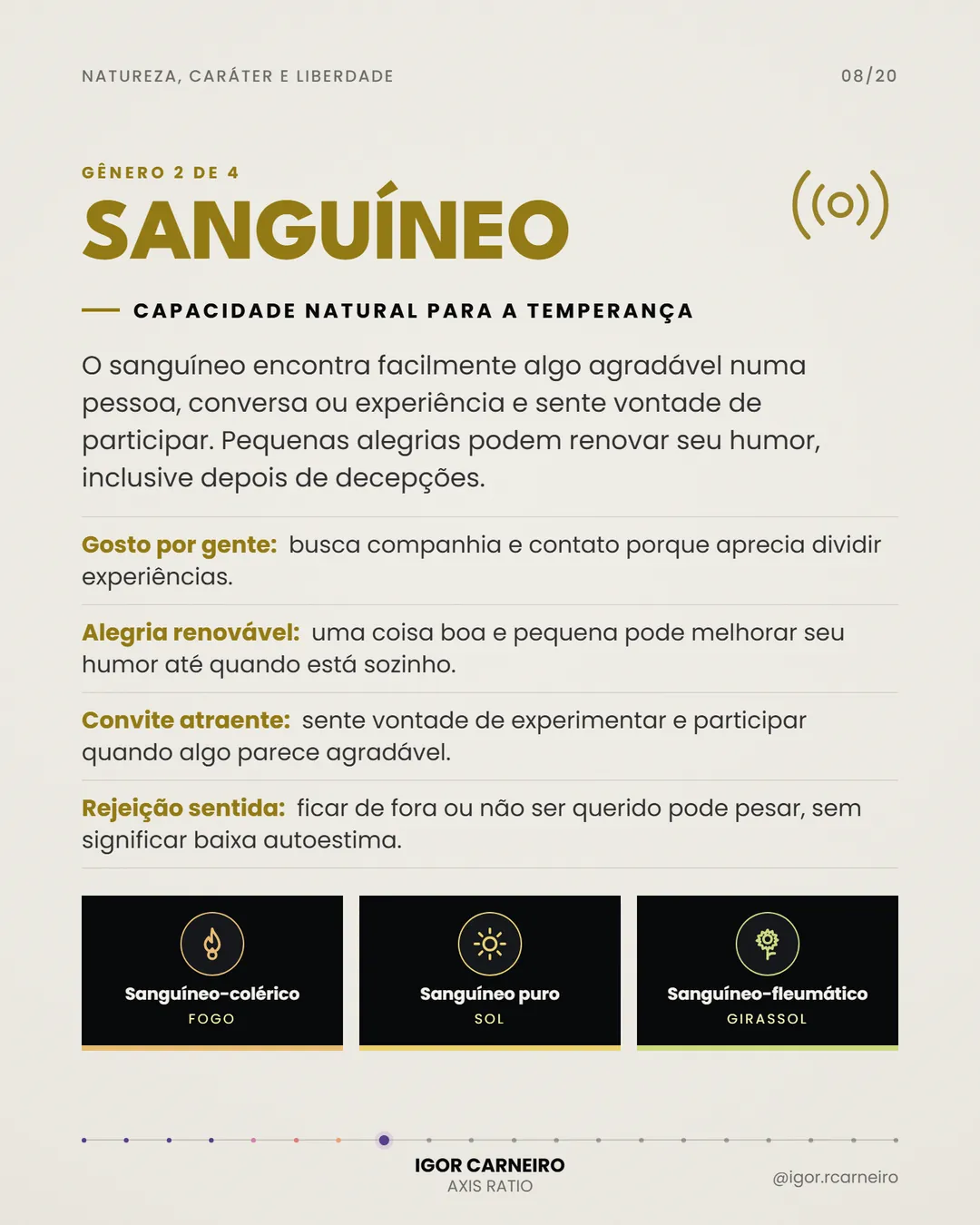
THE SANGUINE.
The sanguine easily finds something pleasant in a person, a conversation or an experience and feels like joining in. Small joys can renew his mood, even after disappointments.
A liking for people: he seeks company and contact because he enjoys sharing experiences.
Renewable joy: a small good thing can lift his mood even when he is alone.
An appealing invitation: he feels like trying and taking part when something seems pleasant.
Rejection that hurts: being left out or not being wanted can weigh on him, without meaning low self-esteem.
 09
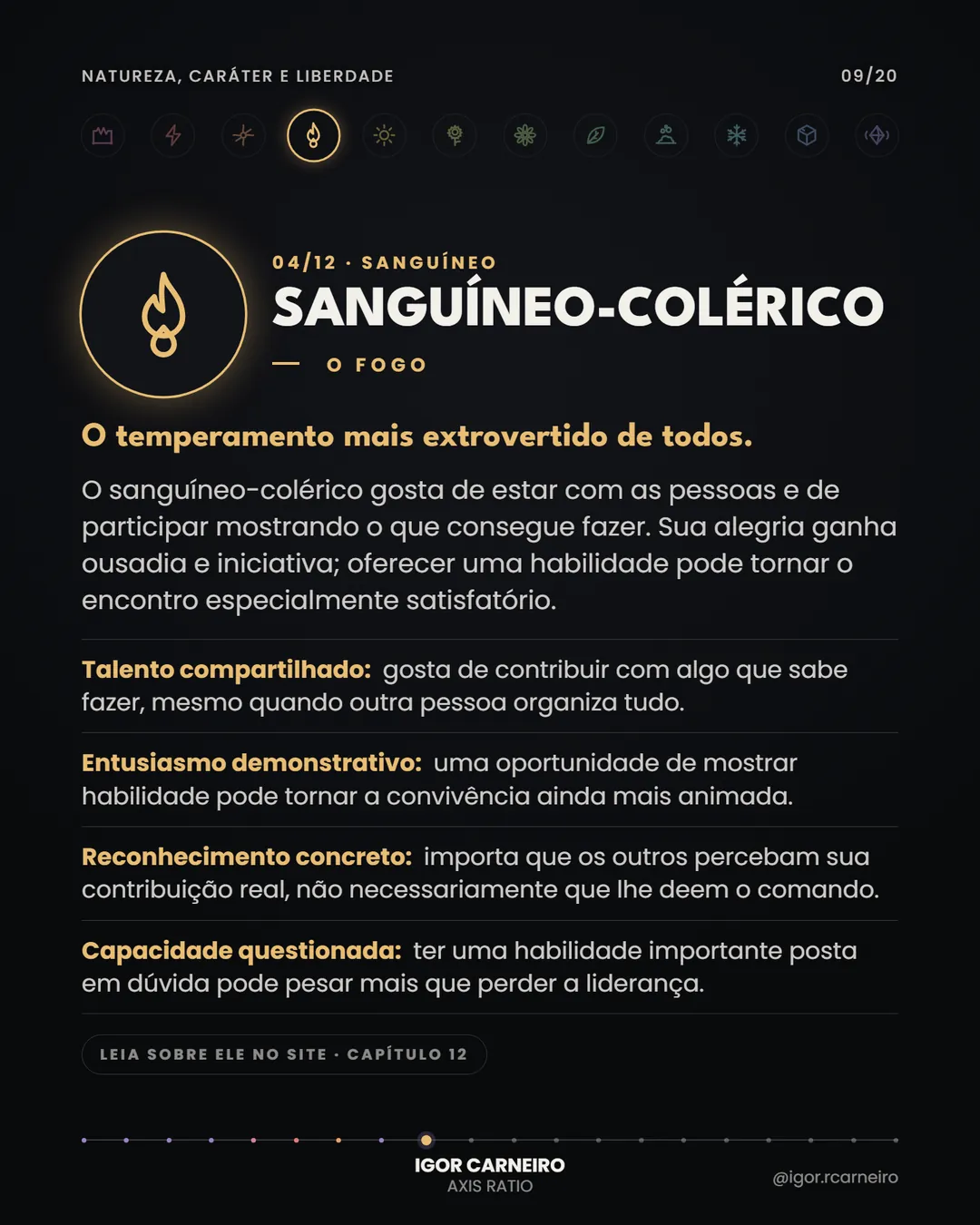
SANGUINE-CHOLERIC.
The most extroverted temperament of all.
The sanguine-choleric likes being with people and taking part by showing what he can do. His joy gains boldness and initiative; offering a skill can make the gathering especially satisfying.
Shared talent: he likes to contribute something he knows how to do, even when someone else organizes everything.
Demonstrative enthusiasm: a chance to show his skill can make being together even livelier.
Concrete recognition: what matters is that others notice his real contribution, not necessarily that they put him in charge.
Ability called into question: having an important skill of his doubted can weigh more than losing the lead.
 10
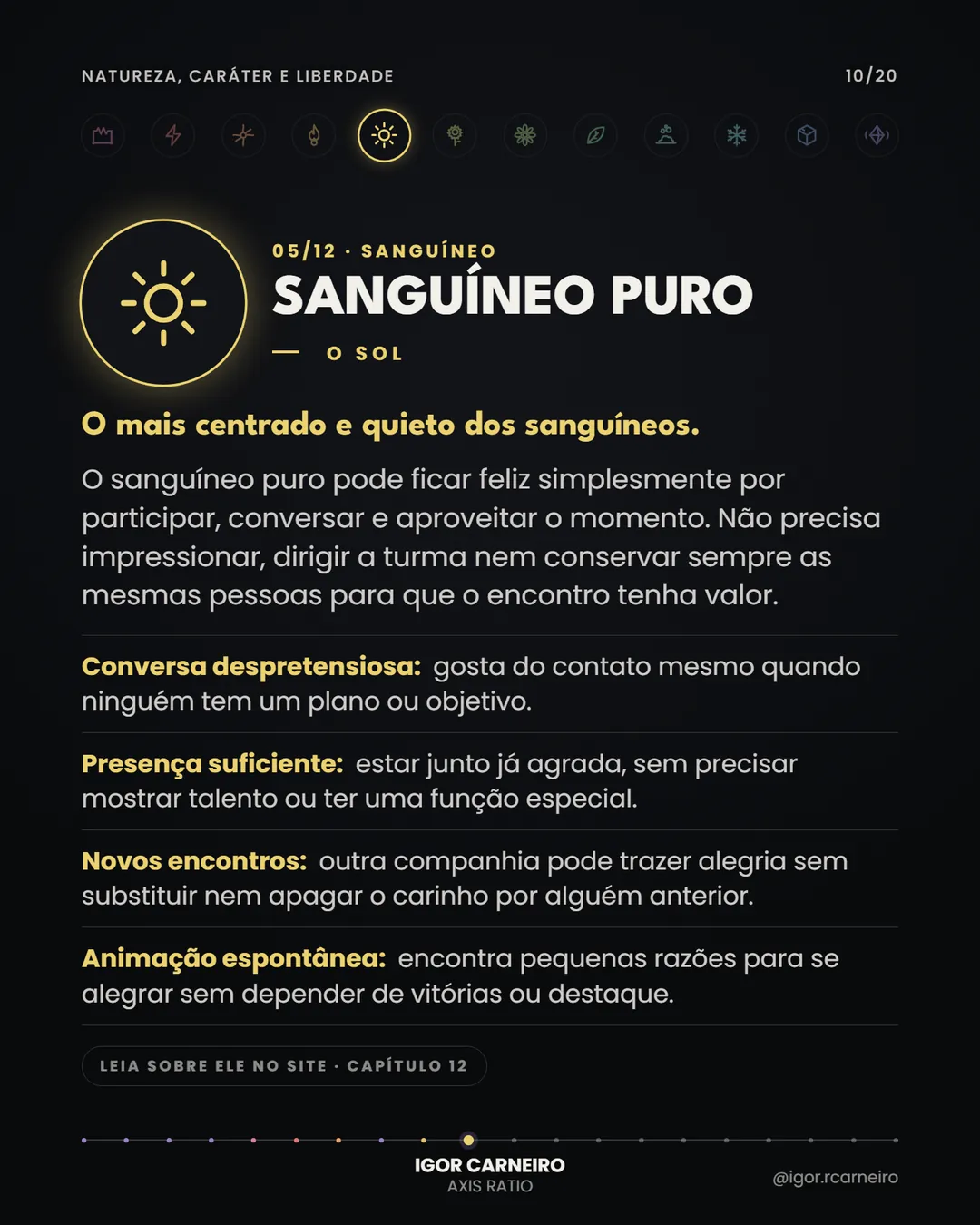
PURE SANGUINE.
The most centered and quiet of the sanguines.
The pure sanguine can be happy simply to take part, talk and enjoy the moment. He does not need to impress, lead the group or always keep the same people around for the gathering to have value.
Unpretentious conversation: he likes contact even when no one has a plan or a goal.
Presence is enough: being together already pleases him, without needing to show talent or have a special role.
New encounters: other company can bring joy without replacing or erasing his affection for someone before.
Spontaneous cheer: he finds small reasons to be glad without depending on victories or the spotlight.
 11
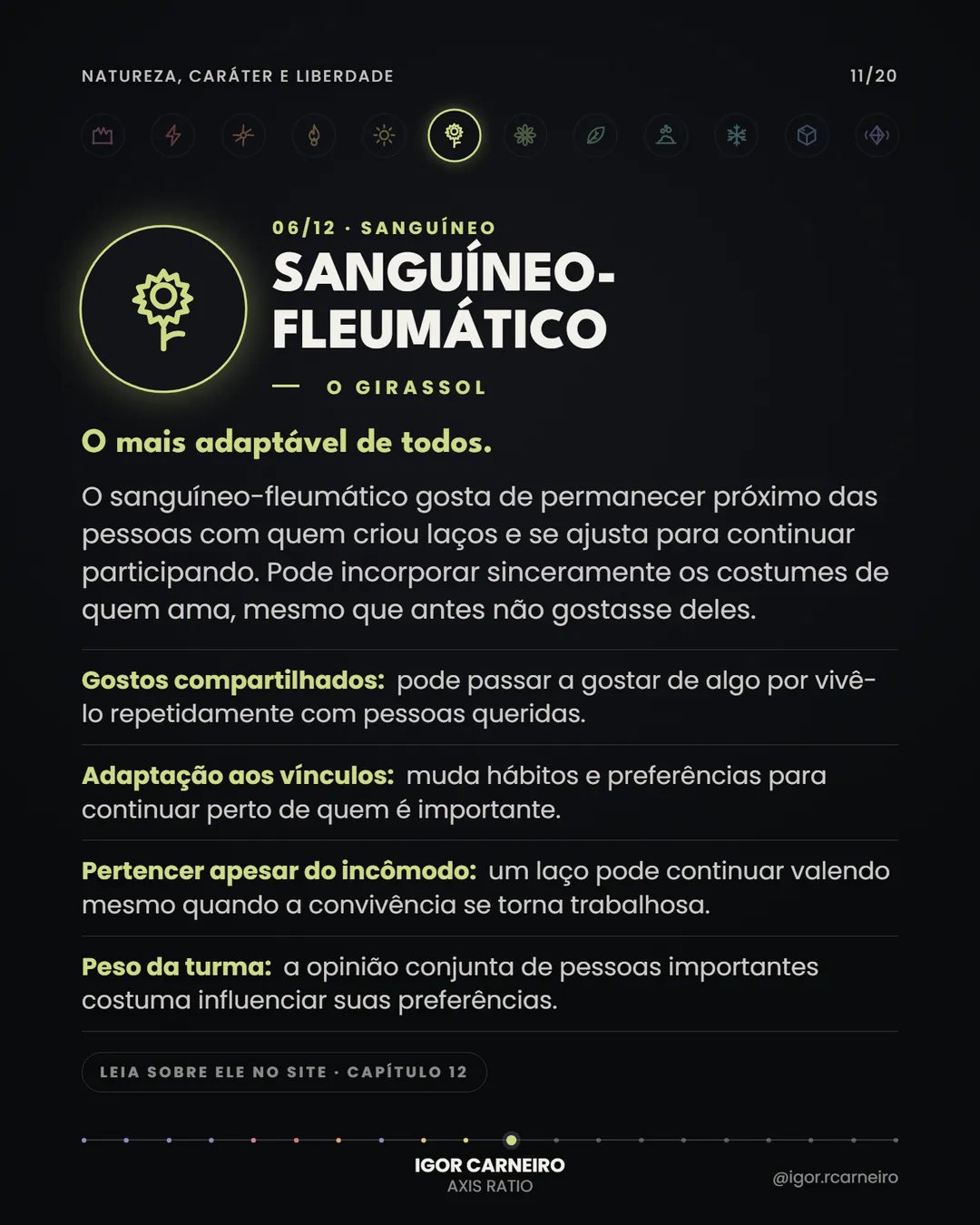
SANGUINE-PHLEGMATIC.
The most adaptable of all.
The sanguine-phlegmatic likes to stay close to the people he has bonded with and adjusts himself to keep taking part. He can sincerely take on the customs of those he loves, even if he did not like them before.
Shared tastes: he can come to like something by living it again and again with people dear to him.
Adapting to bonds: he changes habits and preferences to stay close to those who matter.
Belonging despite discomfort: a bond can still count even when being together becomes hard work.
The weight of the group: the shared opinion of people who matter tends to shape his preferences.
 12
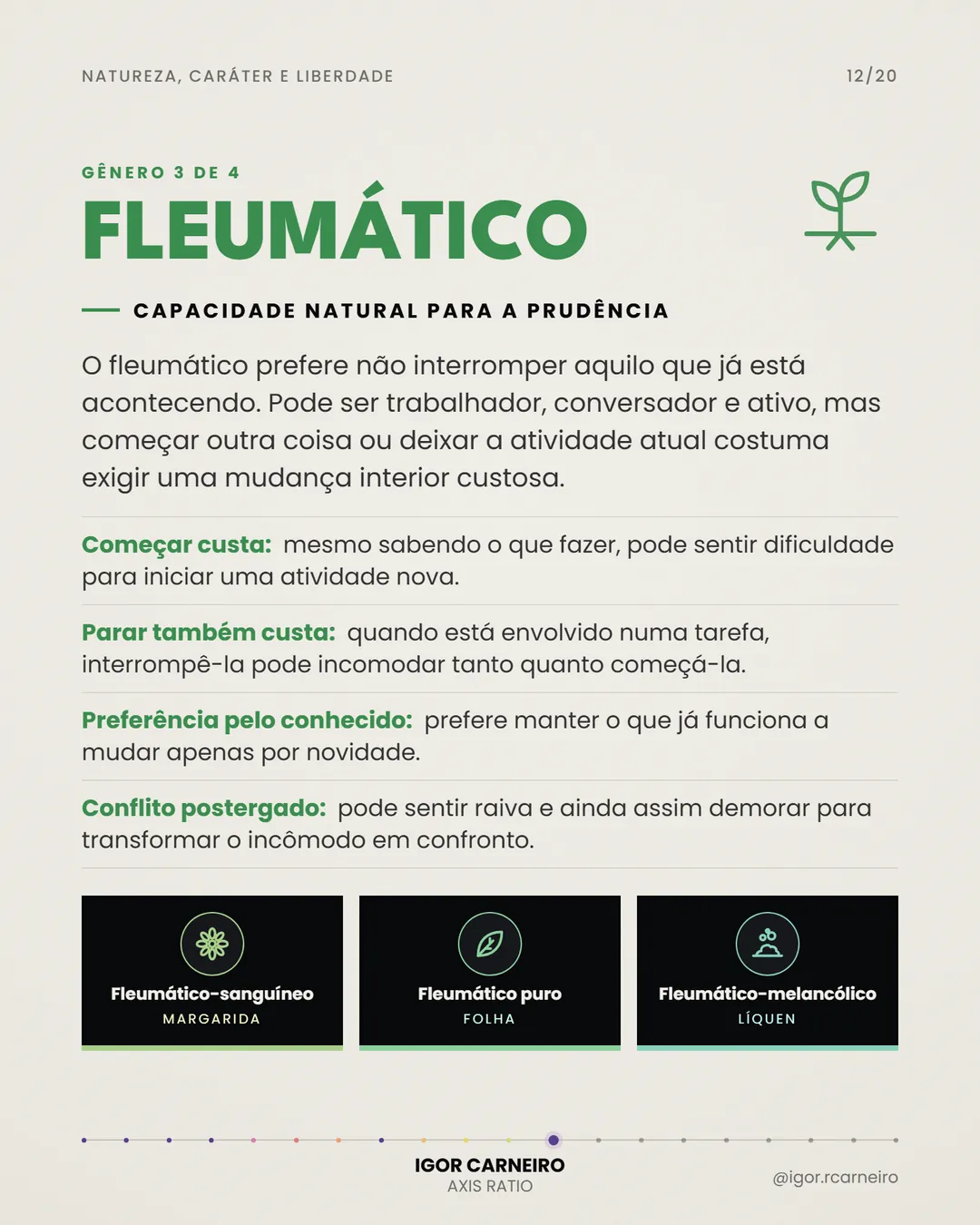
THE PHLEGMATIC.
The phlegmatic prefers not to interrupt what is already happening. He can be hardworking, talkative and active, but starting something else or leaving his current activity tends to demand a costly inner change.
Starting is hard: even knowing what to do, he may find it difficult to begin a new activity.
Stopping is hard too: when he is caught up in a task, interrupting it can bother him as much as starting it.
Preference for the familiar: he would rather keep what already works than change just for the sake of novelty.
Conflict put off: he can feel anger and still take a long time to turn the discomfort into confrontation.
 13
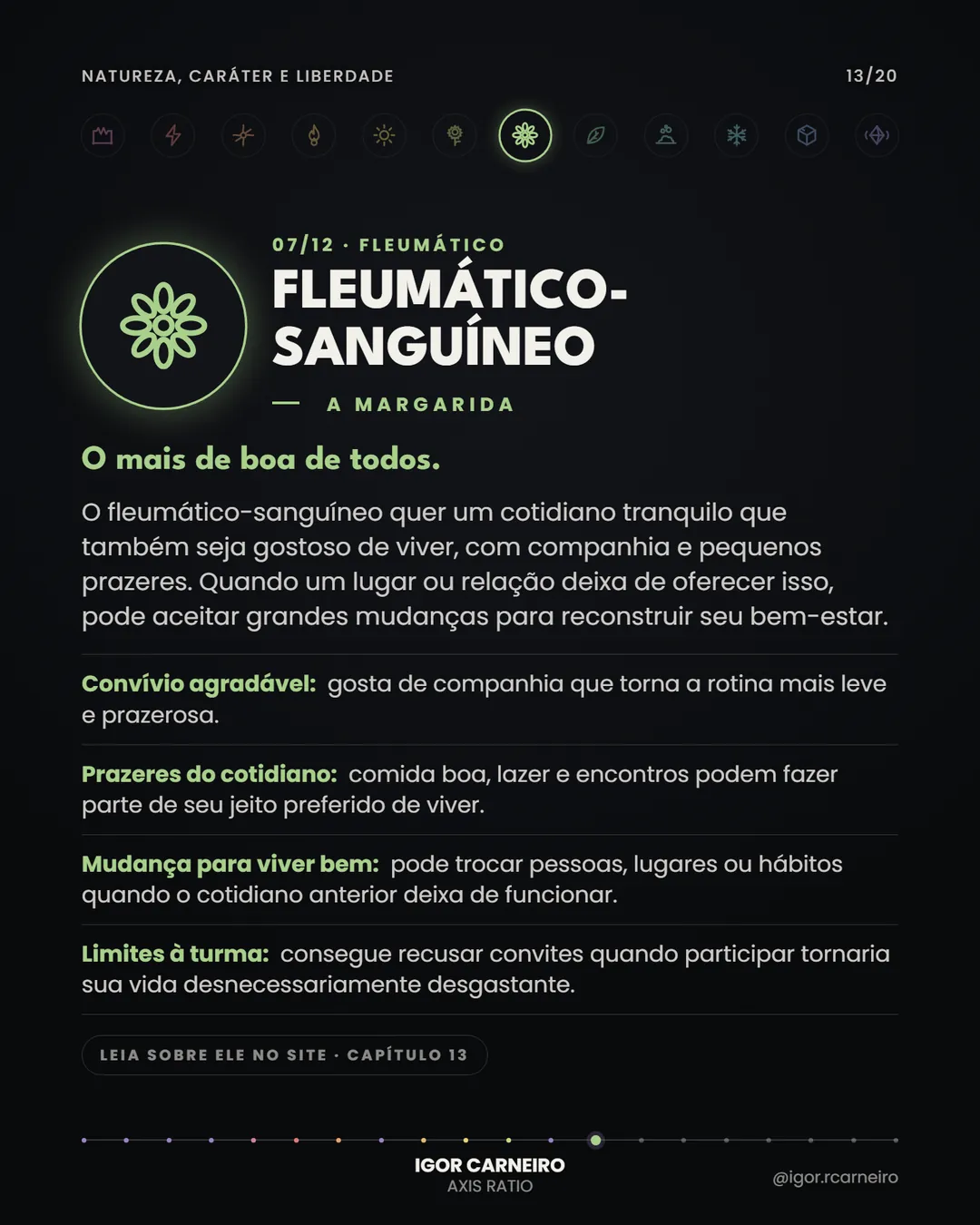
PHLEGMATIC-SANGUINE.
The most easygoing of all.
The phlegmatic-sanguine wants a calm everyday life that is also pleasant to live, with company and small pleasures. When a place or a relationship stops offering him that, he can accept big changes to rebuild his well-being.
Pleasant company: he likes company that makes the routine lighter and more enjoyable.
Everyday pleasures: good food, leisure and get-togethers can be part of his favorite way of living.
Change in order to live well: he can swap people, places or habits when his former everyday life stops working.
Limits with the group: he is able to turn down invitations when taking part would make his life needlessly draining.
 14
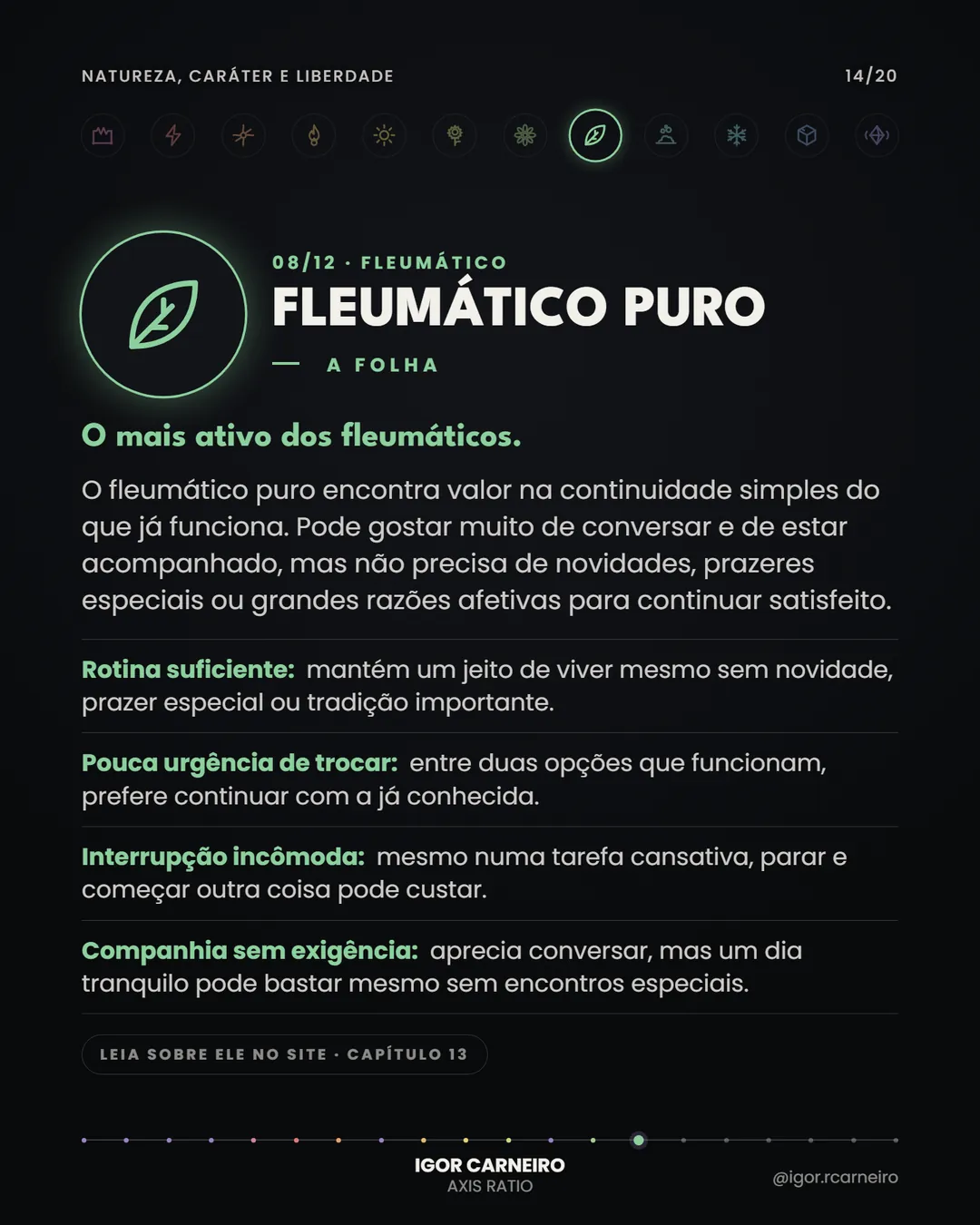
PURE PHLEGMATIC.
The most active of the phlegmatics.
The pure phlegmatic finds value in the simple continuity of what already works. He may love talking and having company, but he does not need novelty, special pleasures or great emotional reasons to stay content.
A routine that is enough: he keeps a way of living even without novelty, special pleasure or an important tradition.
Little urge to switch: between two options that work, he prefers to stay with the one he already knows.
Uncomfortable interruption: even in a tiring task, stopping and starting something else can be costly for him.
Undemanding company: he enjoys talking, but a quiet day can be enough even without special get-togethers.
 15
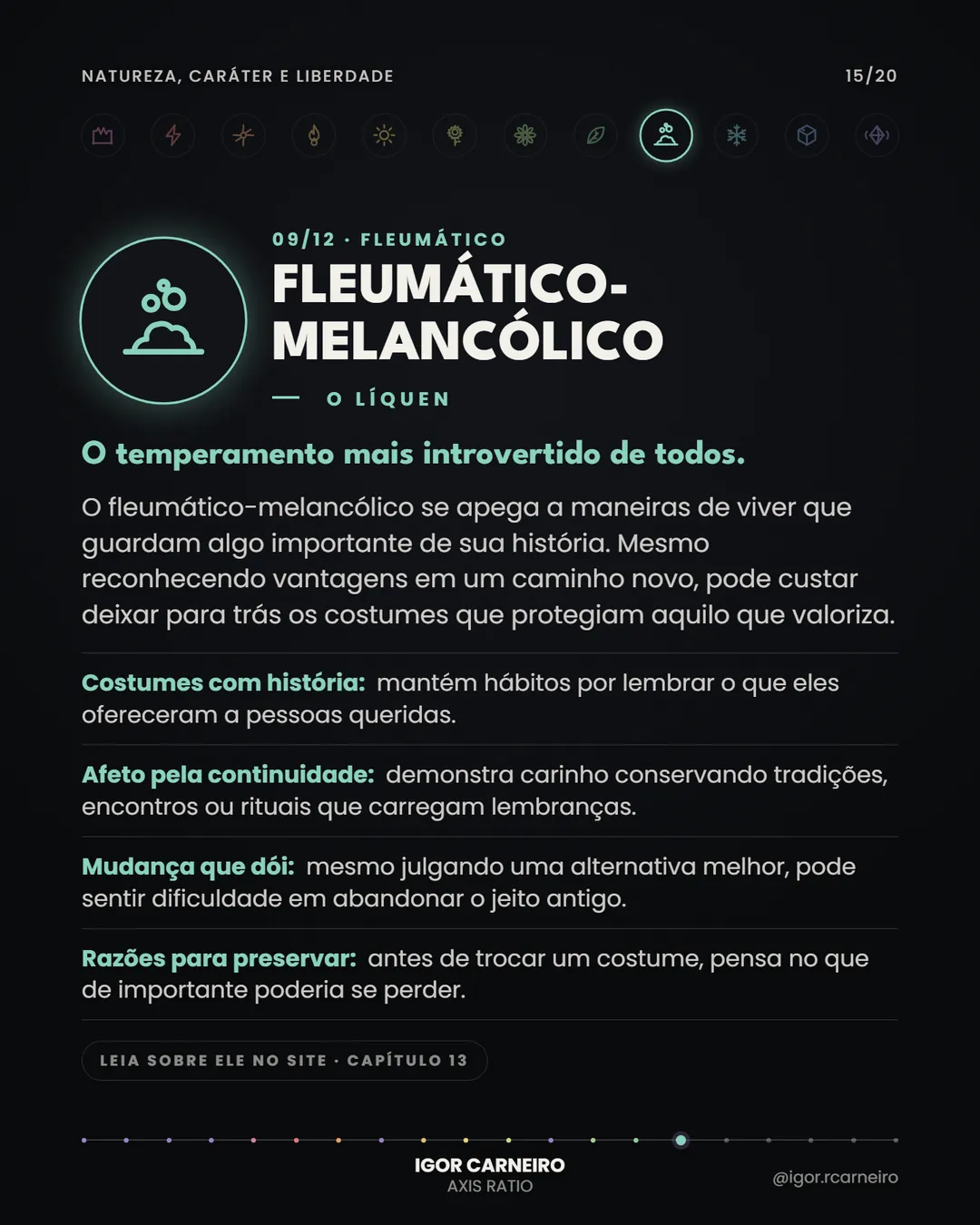
PHLEGMATIC-MELANCHOLIC.
The most introverted temperament of all.
The phlegmatic-melancholic grows attached to ways of living that hold something important from his history. Even when he recognizes advantages in a new path, it can be hard for him to leave behind the customs that protected what he values.
Customs with a history: he keeps habits because he remembers what they gave to people dear to him.
Affection through continuity: he shows love by keeping traditions, gatherings or rituals that carry memories.
Change that hurts: even judging an alternative to be better, he may find it hard to abandon the old way.
Reasons to preserve: before changing a custom, he thinks about what important thing could be lost.
 16
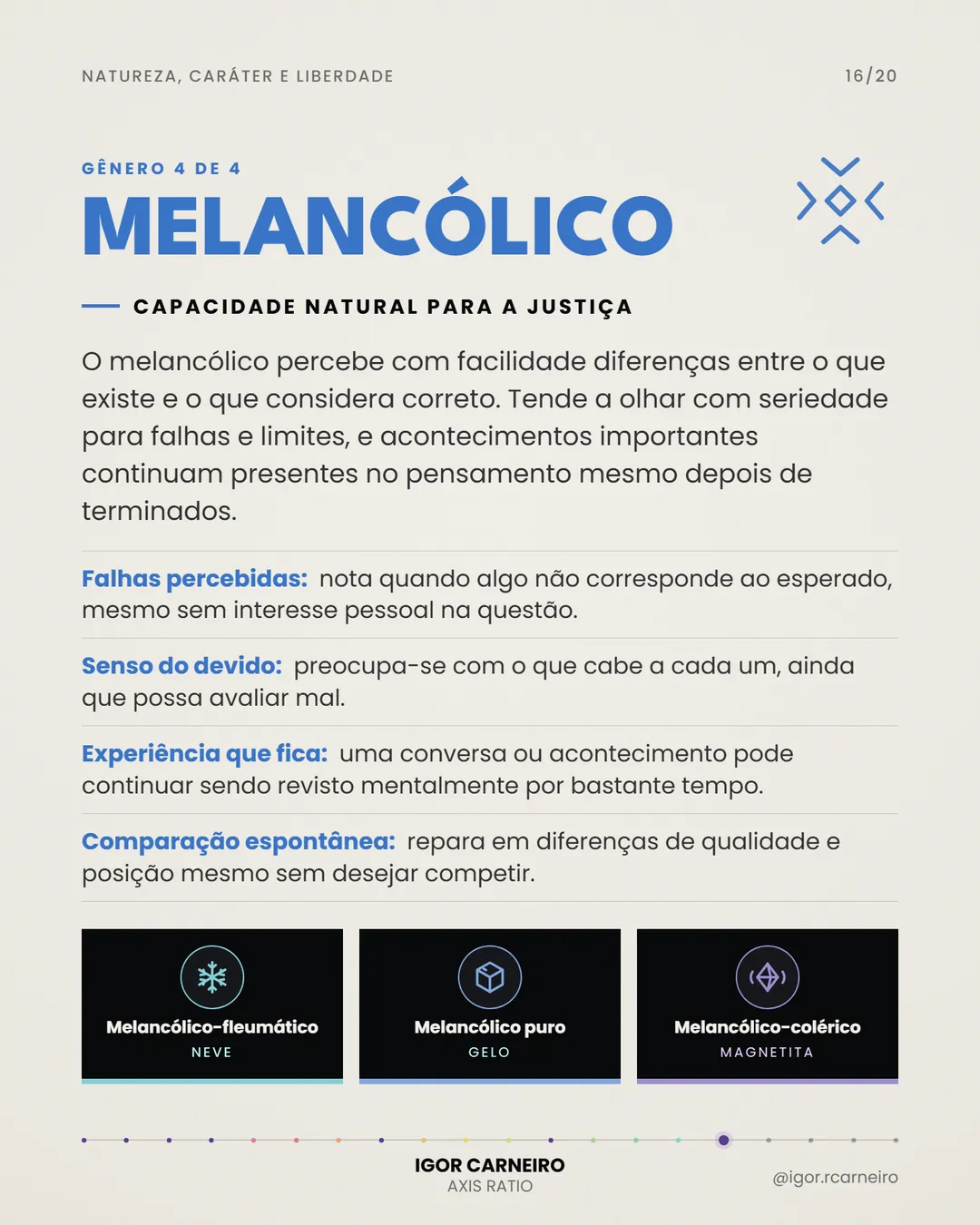
THE MELANCHOLIC.
The melancholic easily notices differences between what exists and what he considers right. He tends to look seriously at failings and limits, and important events remain present in his thoughts even after they are over.
Failings noticed: he notices when something does not match what was expected, even without any personal interest in the matter.
A sense of what is due: he is concerned with what belongs to each one, even though he may judge wrongly.
Experience that stays: a conversation or an event can keep being gone over in his mind for quite a long time.
Spontaneous comparison: he notices differences in quality and position even without wanting to compete.
 17
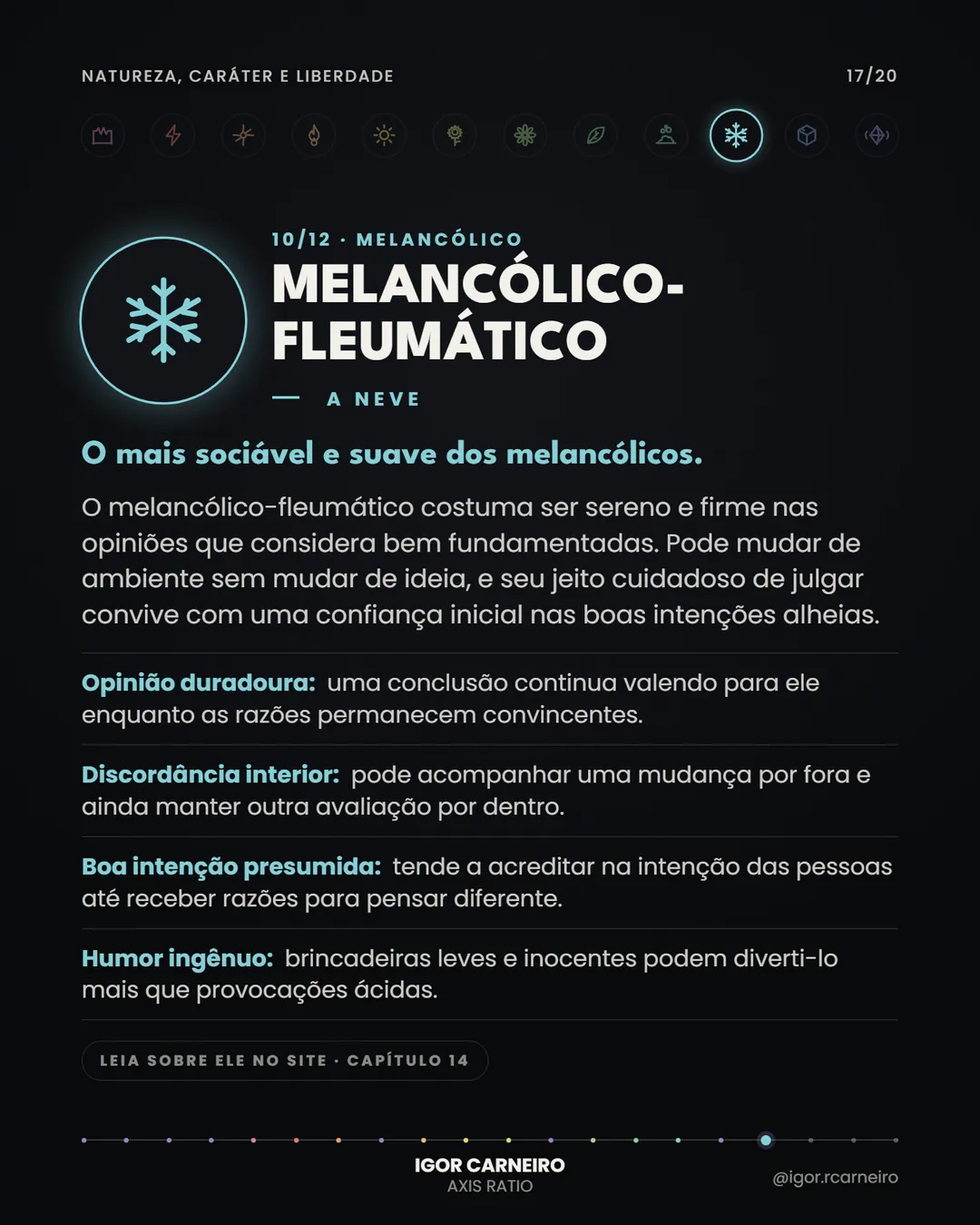
MELANCHOLIC-PHLEGMATIC.
The most sociable and gentle of the melancholics.
The melancholic-phlegmatic tends to be serene and firm in the opinions he considers well founded. He can change surroundings without changing his mind, and his careful way of judging coexists with an initial trust in other people's good intentions.
Lasting opinion: a conclusion stays valid for him as long as the reasons remain convincing.
Inner disagreement: he can go along with a change on the outside and still hold a different assessment on the inside.
Good intentions presumed: he tends to believe in people's intentions until he is given reasons to think otherwise.
Innocent humor: light and innocent jokes can amuse him more than sharp-edged teasing.
 18
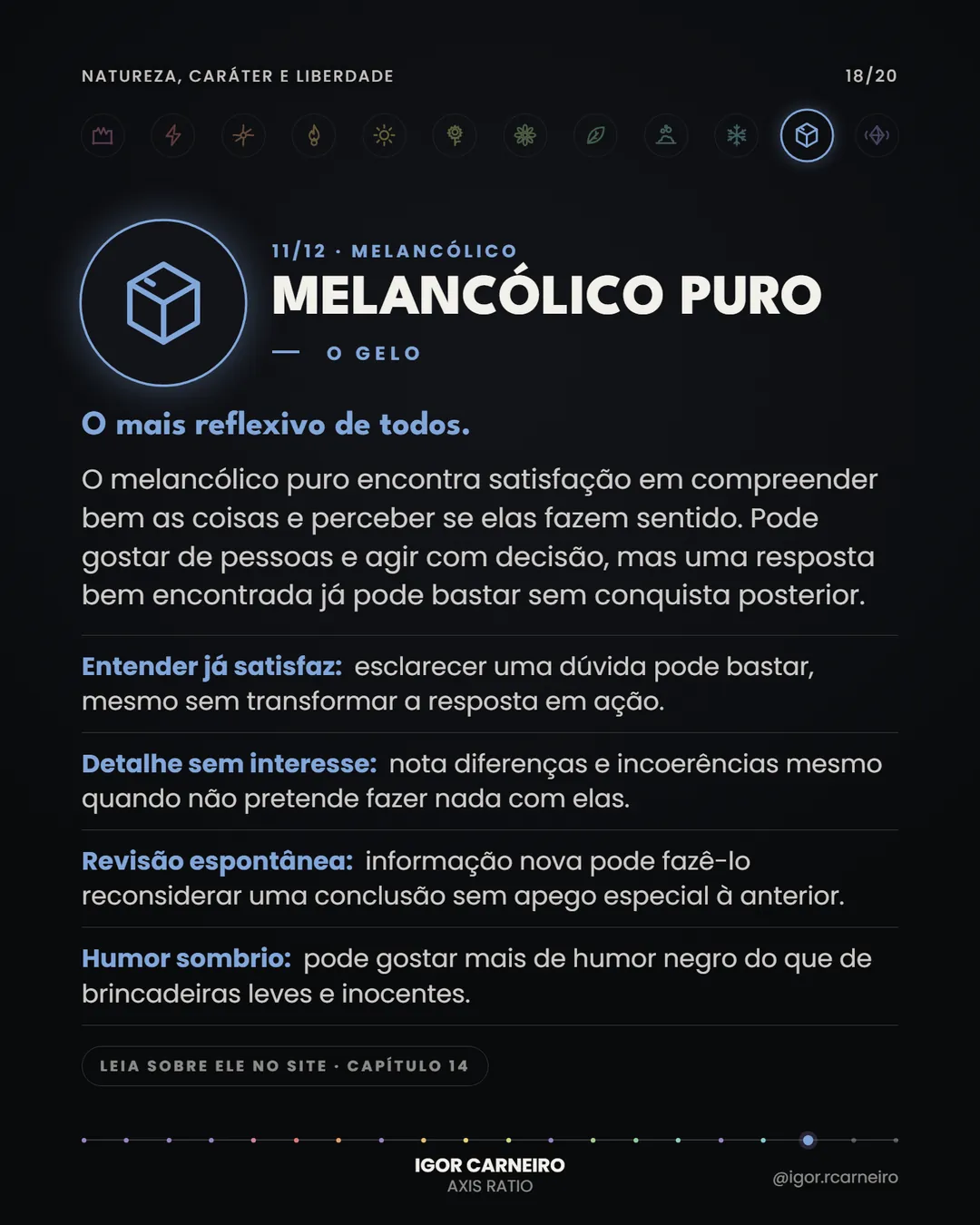
PURE MELANCHOLIC.
The most reflective of all.
The pure melancholic finds satisfaction in understanding things well and seeing whether they make sense. He may like people and act decisively, but a well-found answer can already be enough for him without any further achievement.
Understanding already satisfies: clearing up a question can be enough, even without turning the answer into action.
Detail without interest: he notices differences and inconsistencies even when he does not intend to do anything with them.
Spontaneous revision: new information can make him reconsider a conclusion without any special attachment to the previous one.
Dark humor: he may like black humor more than light and innocent jokes.
 19
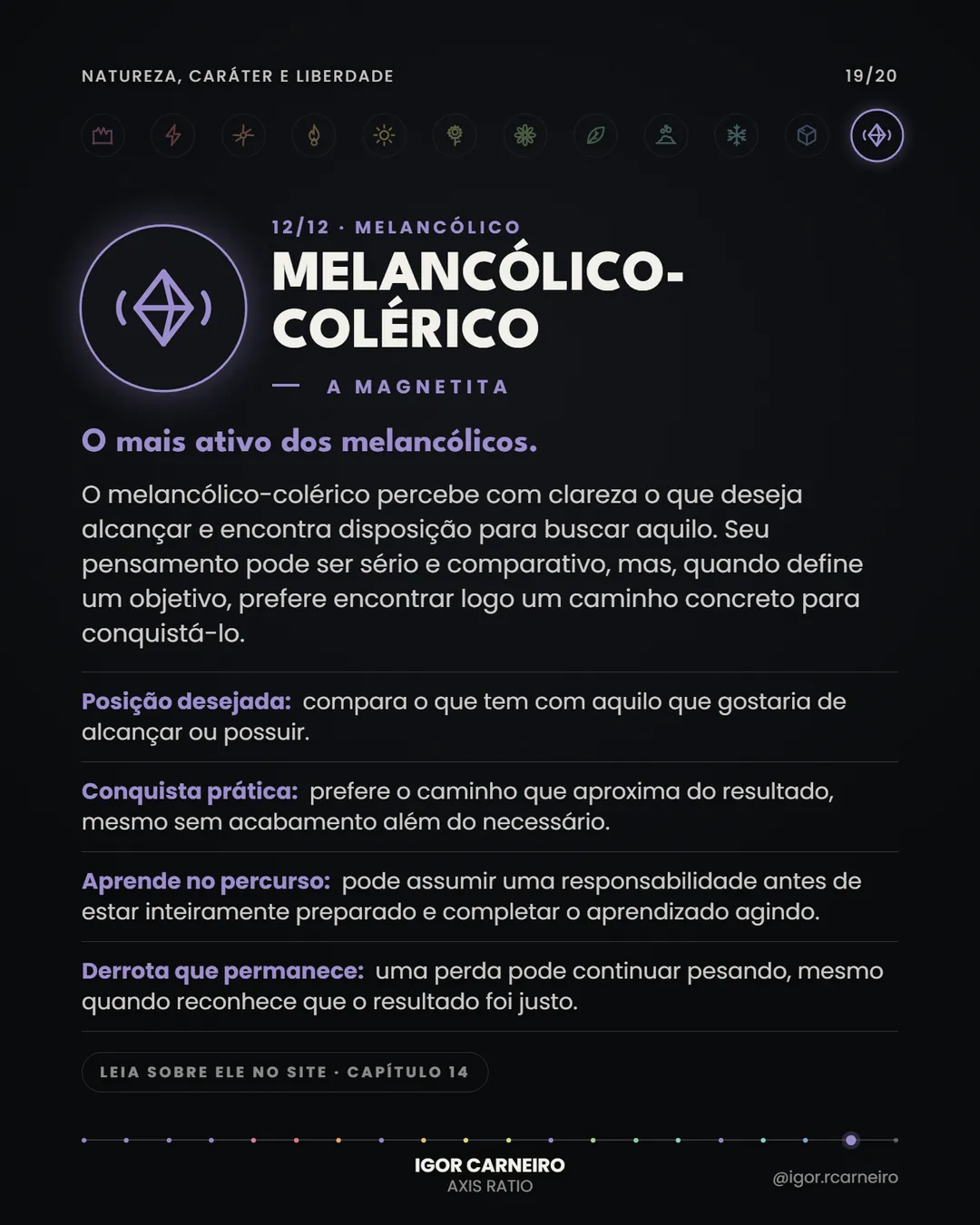
MELANCHOLIC-CHOLERIC.
The most active of the melancholics.
The melancholic-choleric sees clearly what he wants to achieve and finds the drive to go after it. His thinking can be serious and comparative, but once he sets a goal, he prefers to find a concrete path to reach it quickly.
A desired position: he compares what he has with what he would like to achieve or own.
Practical achievement: he prefers the path that brings him closer to the result, even without any finish beyond what is necessary.
Learns along the way: he can take on a responsibility before he is fully prepared and complete his learning by acting.
Defeat that lingers: a loss can keep weighing on him, even when he recognizes the outcome was fair.
 20
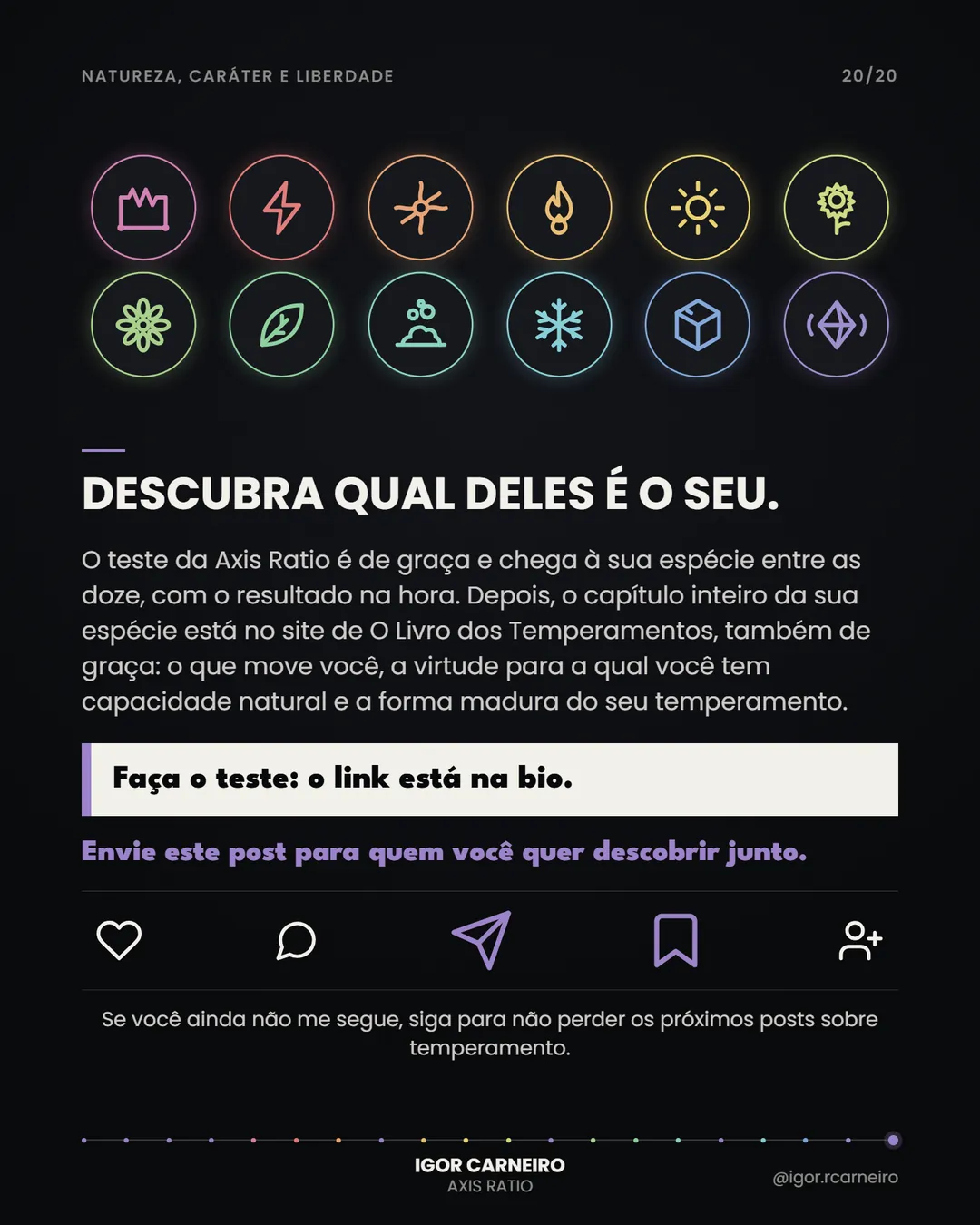
FIND OUT WHICH ONE IS YOURS.
The Axis Ratio test is free and arrives at your species among the twelve, with the result right away. Afterward, the full chapter on your species is on The Book of Temperaments website, also free: what moves you, the virtue for which you have a natural capacity and the mature form of your temperament.
Take the test: the link is in the bio.
Send this post to someone you want to find out with.
If you don't follow me yet, follow me so you won't miss the next posts on temperament.