
You study and study… and never finish?
How to use your temperament to get through the material, learn, and keep going. Guidance for the 12 temperaments according to Axis Ratio.

 02
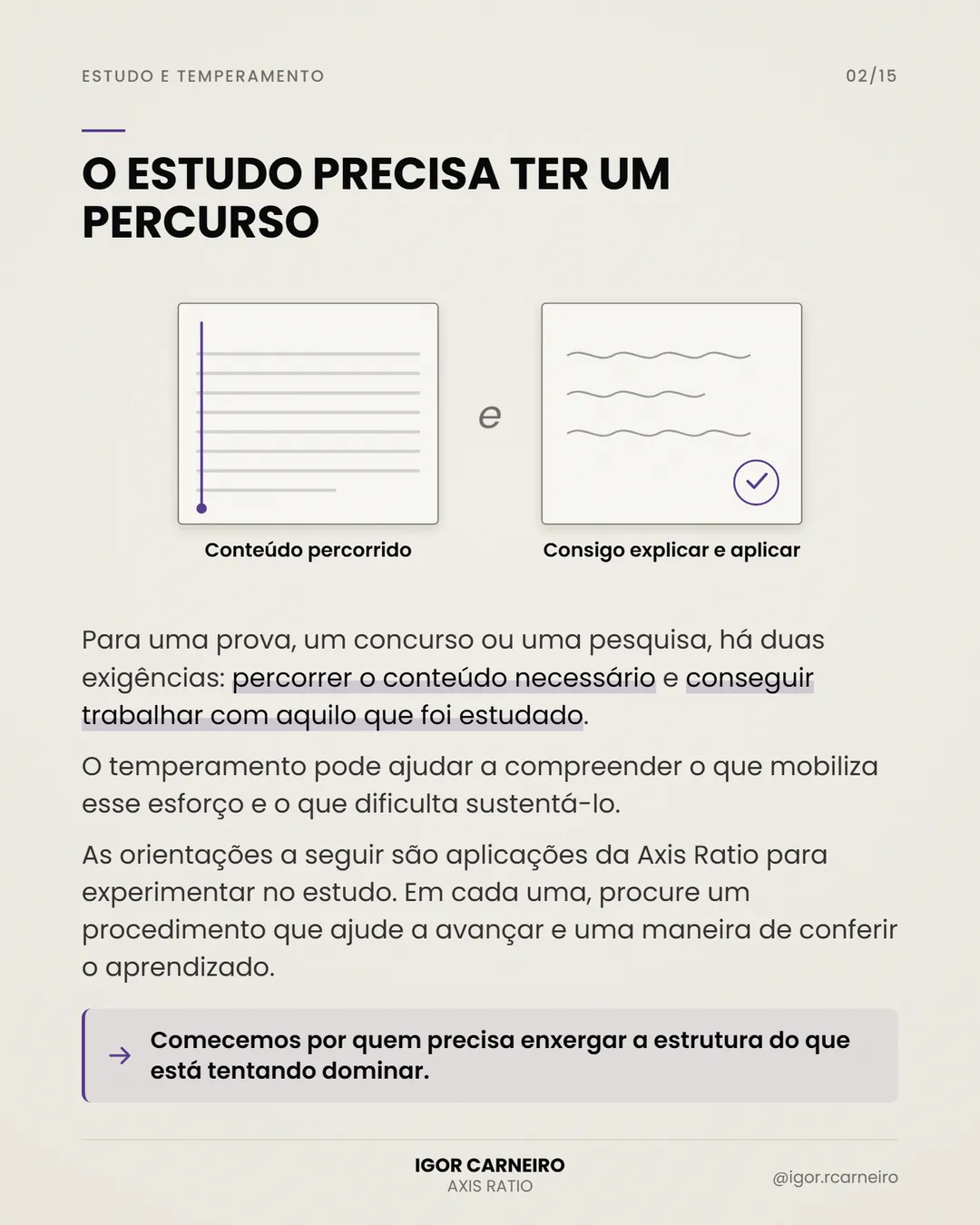
STUDY NEEDS A PATH
For an exam, a civil service test, or a research project, there are two demands: getting through the necessary material and being able to work with what you studied.
Temperament can help you understand what drives that effort and what makes it hard to sustain.
The guidance below consists of applications of Axis Ratio to try out in your studies. In each one, look for a procedure that helps you move forward and a way to check what you have learned.
Let us begin with those who need to see the structure of what they are trying to master.
 03
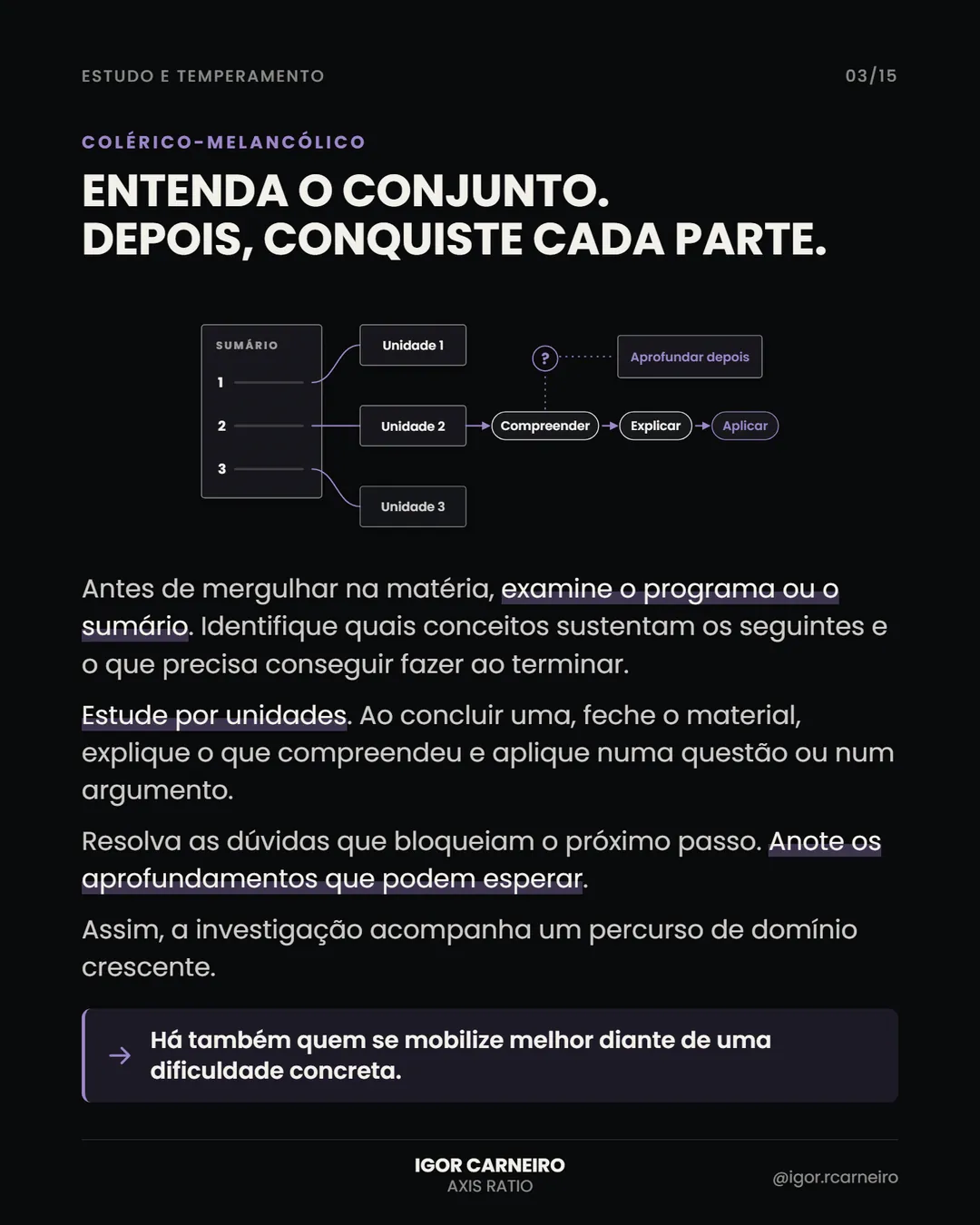
UNDERSTAND THE WHOLE. THEN CONQUER EACH PART.
CHOLERIC-MELANCHOLIC
Before diving into the material, examine the syllabus or the table of contents. Identify which concepts support the ones that follow and what you need to be able to do when you finish.
Study by units. When you finish one, close the material, explain what you understood, and apply it to a question or an argument.
Resolve the doubts that block the next step. Write down the deeper dives that can wait.
This way, your investigation follows a path of growing mastery.
There are also those who get moving best in the face of a concrete difficulty.
 04
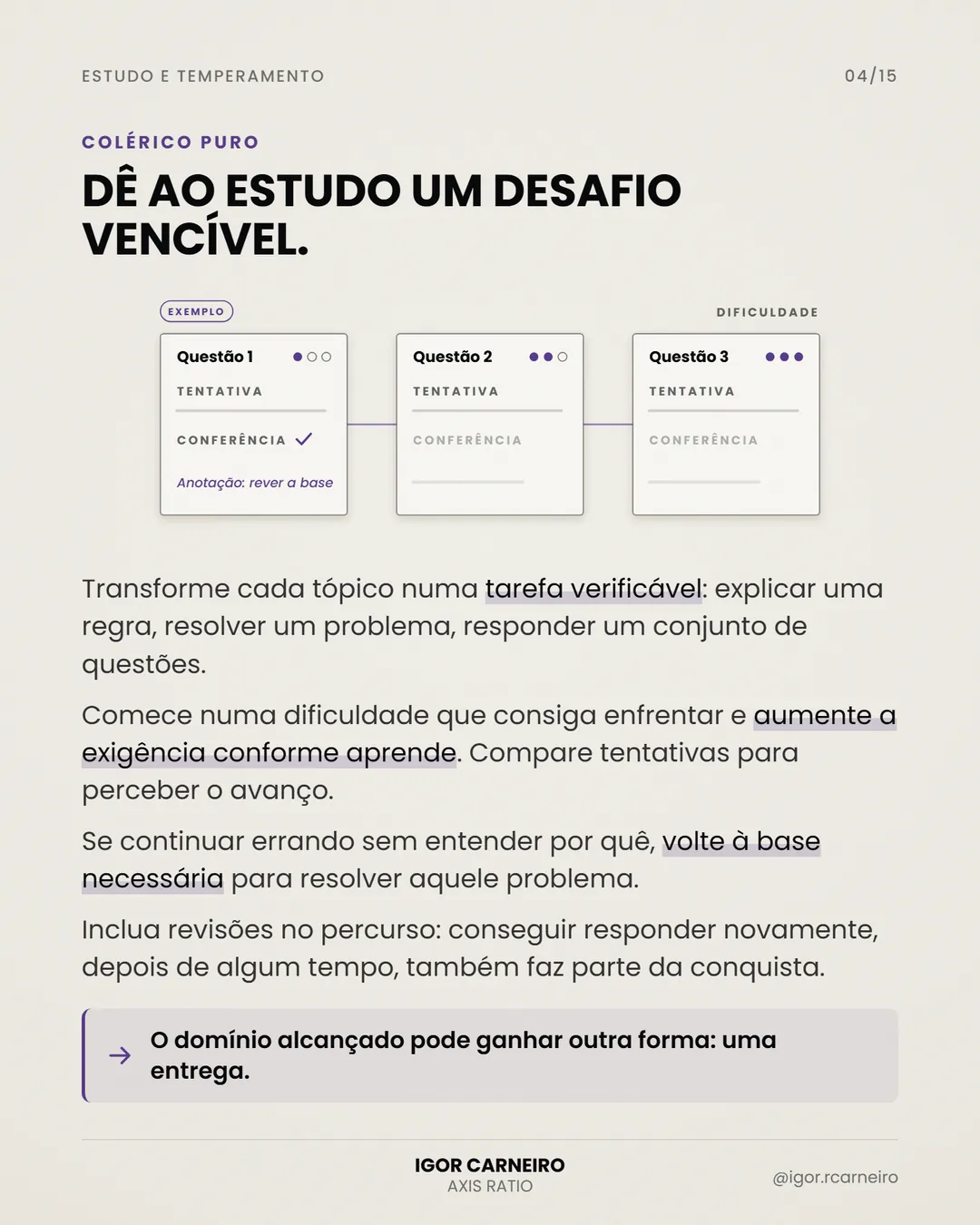
GIVE YOUR STUDY A CHALLENGE YOU CAN WIN.
PURE CHOLERIC
Turn each topic into a task you can check: explaining a rule, solving a problem, answering a set of questions.
Start at a difficulty you can handle and raise the bar as you learn. Compare attempts to see your progress.
If you keep getting it wrong without understanding why, go back to the foundation needed to solve that problem.
Build reviews into the path: being able to answer again, after some time, is also part of the conquest.
The mastery you achieve can take another form: a deliverable.
 05
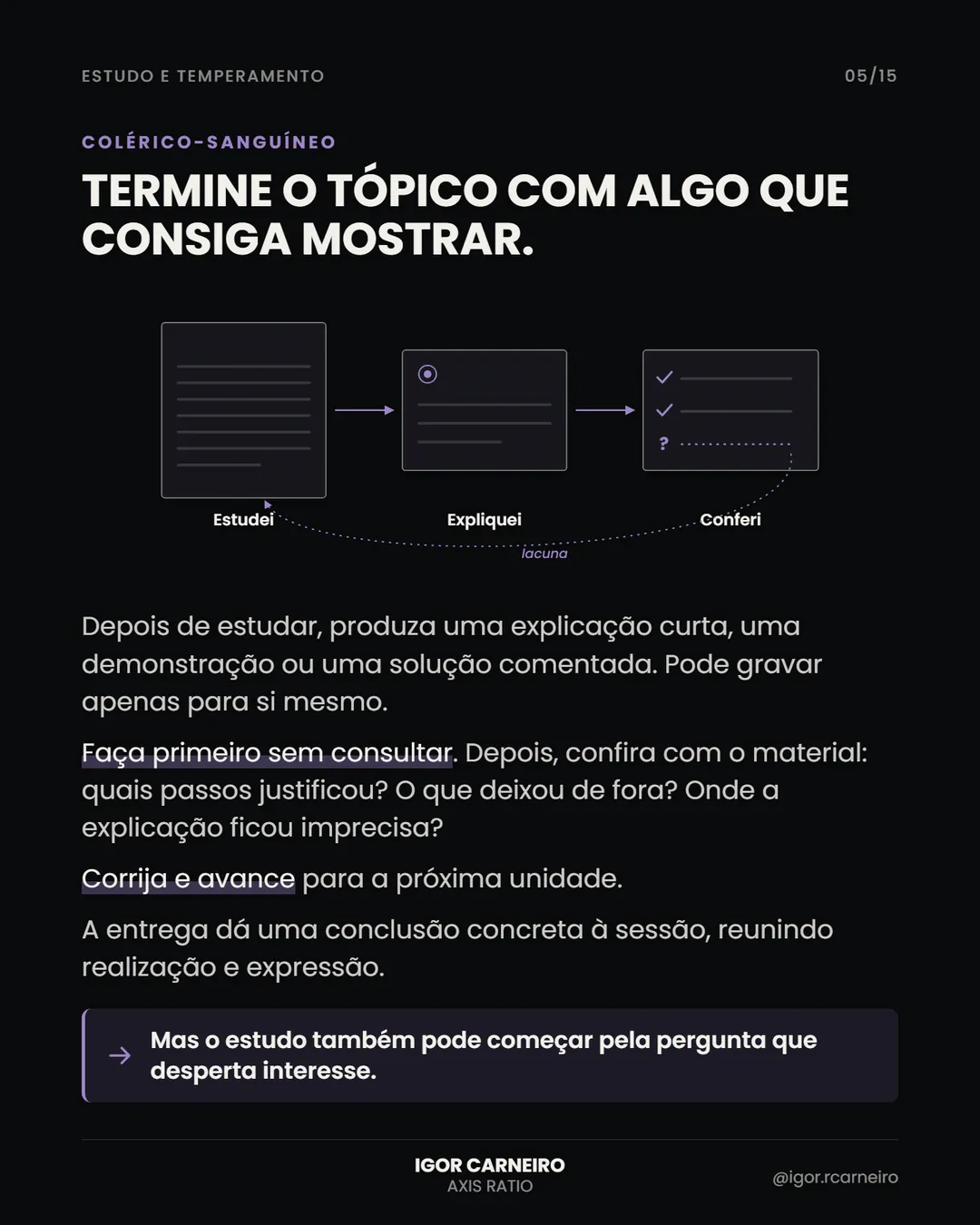
FINISH THE TOPIC WITH SOMETHING YOU CAN SHOW.
CHOLERIC-SANGUINE
After studying, produce a short explanation, a demonstration, or a worked-out solution. You can record it just for yourself.
Do it first without looking anything up. Then check it against the material: which steps did you justify? What did you leave out? Where was the explanation imprecise?
Correct it and move on to the next unit.
The deliverable gives the session a concrete conclusion, bringing together accomplishment and expression.
But study can also begin with the question that sparks interest.
 06
A GOOD QUESTION CAN PULL THE MATERIAL ALONG.
SANGUINE-CHOLERIC
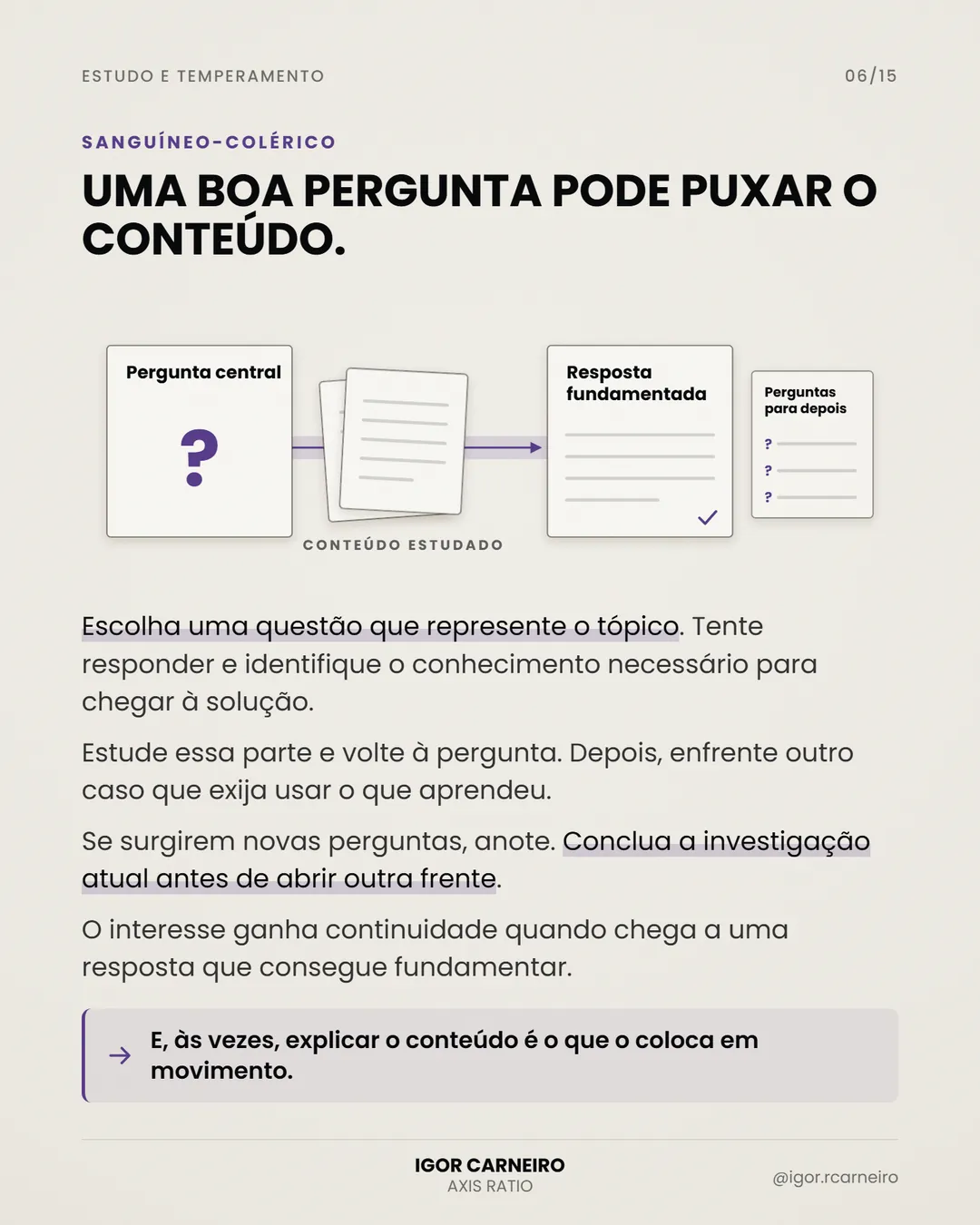
Choose a question that represents the topic. Try to answer it and identify the knowledge needed to reach the solution.
Study that part and go back to the question. Then take on another case that requires using what you learned.
If new questions come up, write them down. Finish the current investigation before opening another front.
Interest gains continuity when it reaches an answer you can back up.
And, sometimes, explaining the material is what sets it in motion.
 07
PUT THE MATERIAL INTO AN EXPLANATION OF YOUR OWN.
PURE SANGUINE
After a section, close the material and explain out loud what you just studied. Build a concrete example.
Go back to the text and check: did the explanation include the necessary concepts? Does the example really correspond to what was stated?
Repeat throughout the syllabus, including the less appealing parts.
This is one way to make use of your outward orientation, working actively with the object of study.
The explanation can also find a partner.
 08
MAKE A COMMITMENT THAT HELPS YOU KEEP GOING.
SANGUINE-PHLEGMATIC
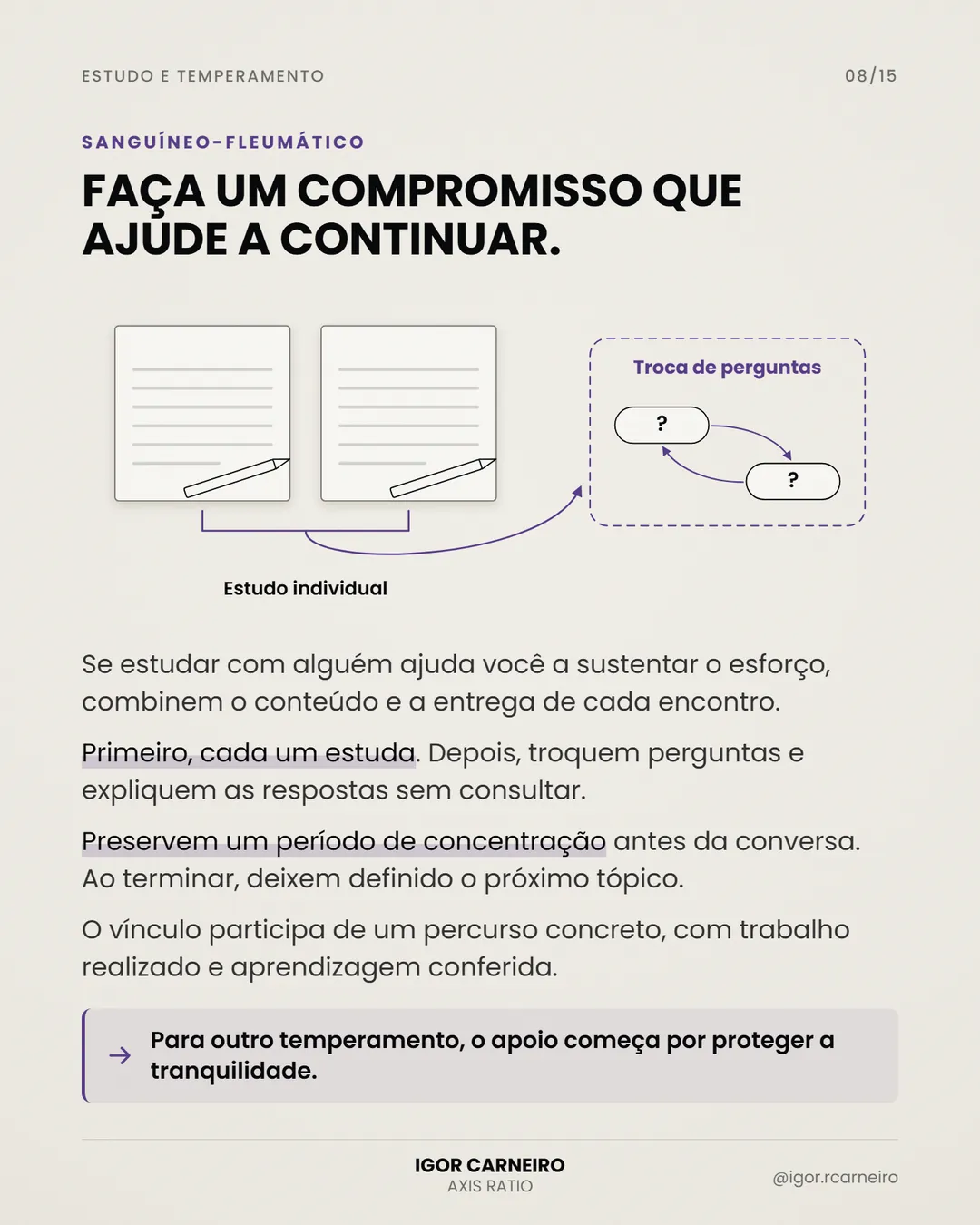
If studying with someone helps you sustain the effort, agree on the material and the deliverable for each meeting.
First, each of you studies. Then, swap questions and explain the answers without looking anything up.
Keep a period of concentration before the conversation. When you finish, leave the next topic decided.
The bond becomes part of a concrete path, with work done and learning checked.
For another temperament, support begins with protecting tranquility.
 09
LEAVE THE WAY BACK READY.
PHLEGMATIC-SANGUINE
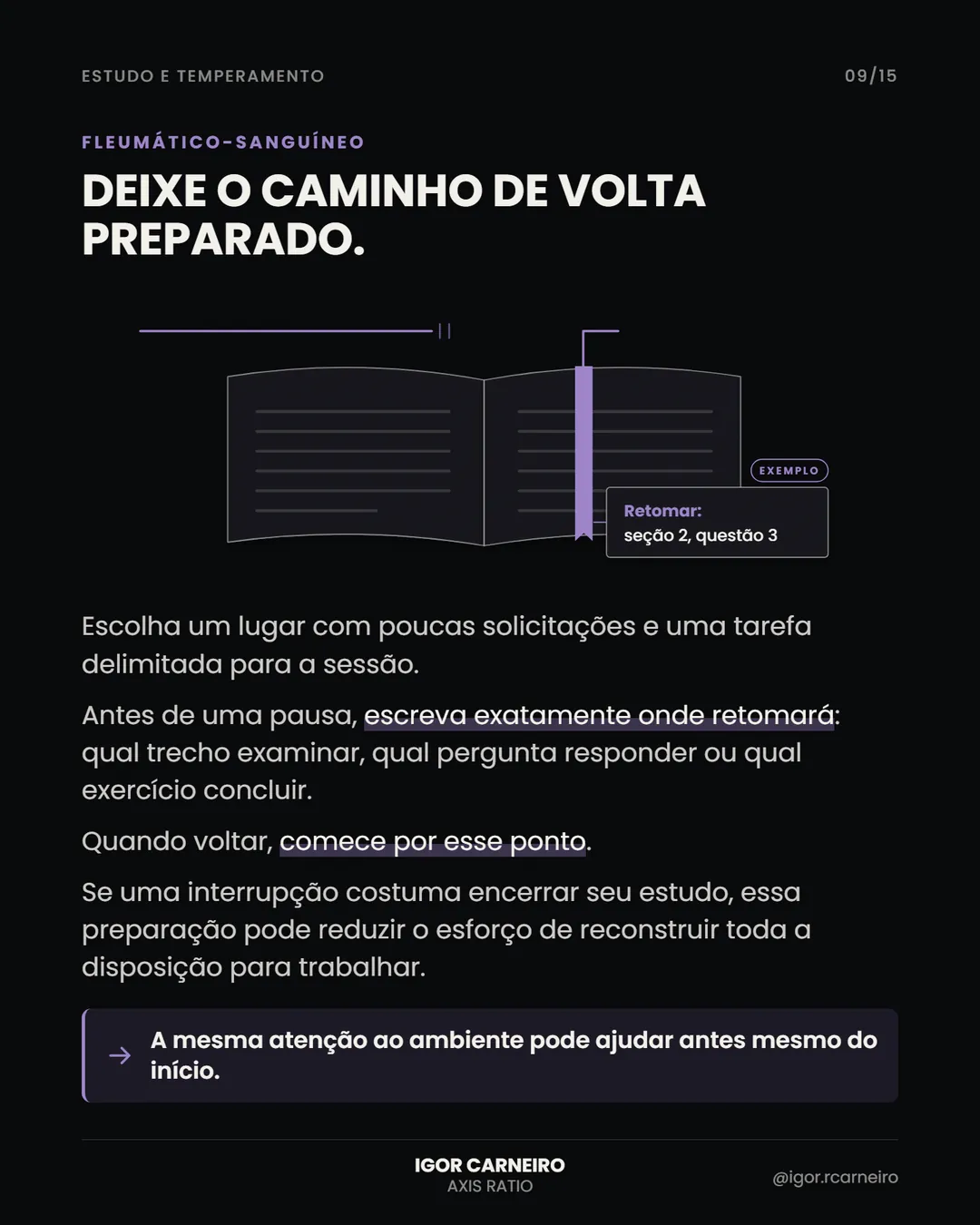
Choose a place with few demands on your attention and a well-defined task for the session.
Before a break, write down exactly where you will pick up: which passage to examine, which question to answer, or which exercise to finish.
When you come back, start from that point.
If an interruption usually ends your study session, this preparation can reduce the effort of rebuilding your whole willingness to work.
The same attention to your surroundings can help even before you begin.
 10
PREPARE THE START BEFORE IT'S TIME TO STUDY.
PURE PHLEGMATIC
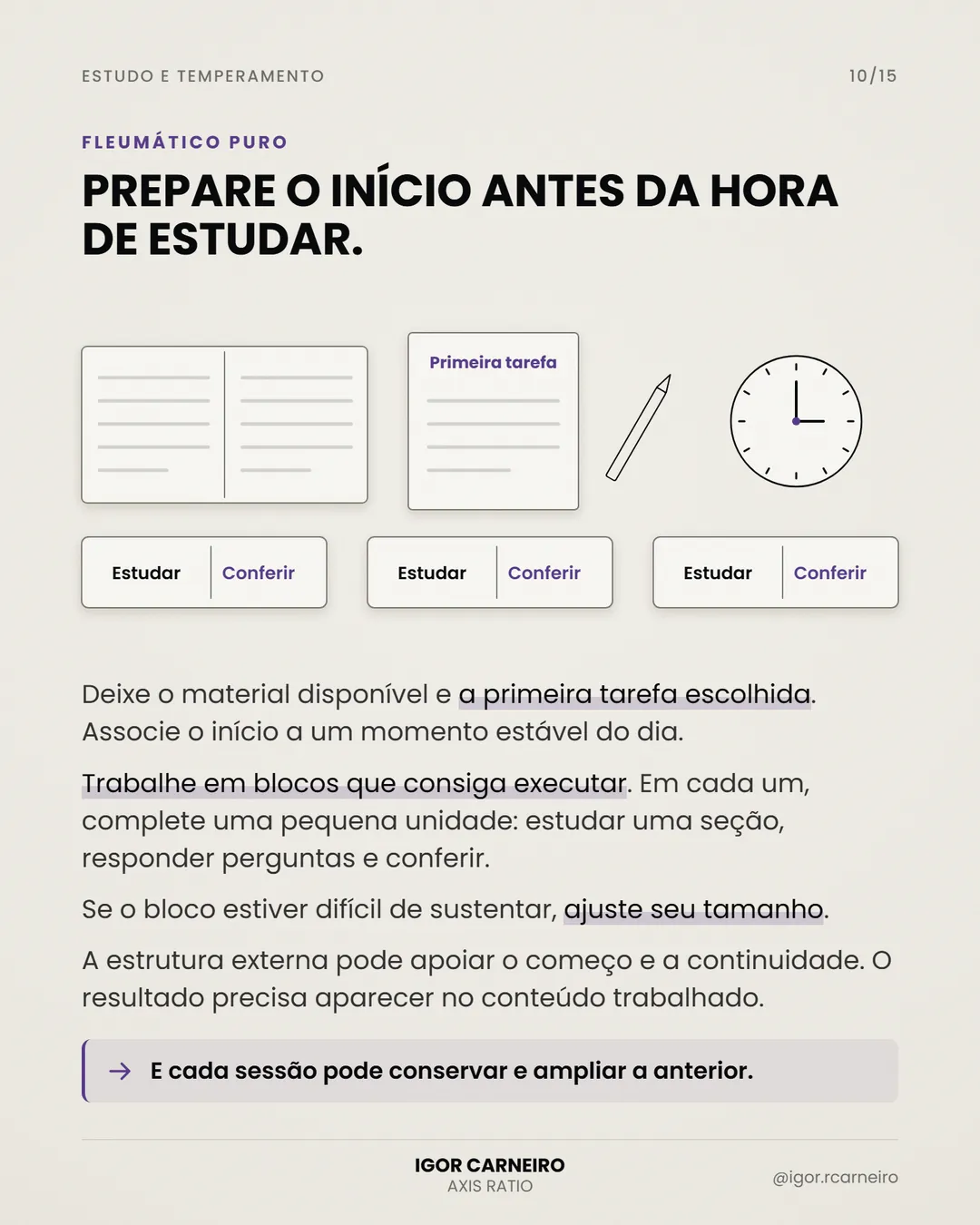
Leave the material ready and the first task chosen. Tie the start to a stable moment of your day.
Work in blocks you can carry out. In each one, complete a small unit: study a section, answer questions, and check.
If a block is hard to sustain, adjust its size.
External structure can support both the start and the continuity. The result needs to show up in the material you worked through.
And each session can preserve and build on the one before.
 11
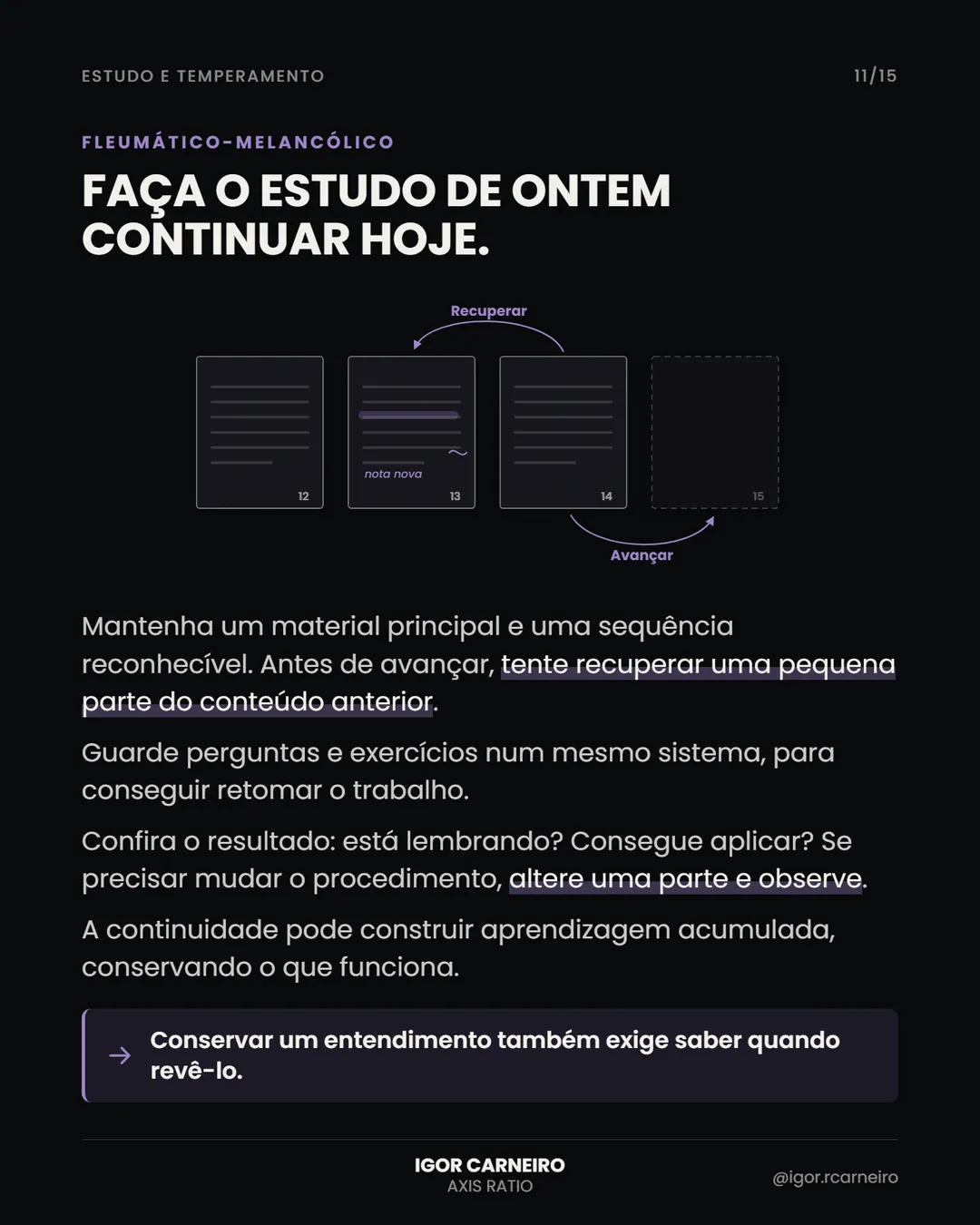
MAKE YESTERDAY'S STUDY CONTINUE TODAY.
PHLEGMATIC-MELANCHOLIC
Keep one main source and a recognizable sequence. Before moving forward, try to recall a small part of the previous material.
Keep questions and exercises in a single system, so you can pick the work back up.
Check the result: are you remembering? Can you apply it? If you need to change the procedure, change one part and observe.
Continuity can build accumulated learning, preserving what works.
Preserving an understanding also requires knowing when to revisit it.
 12
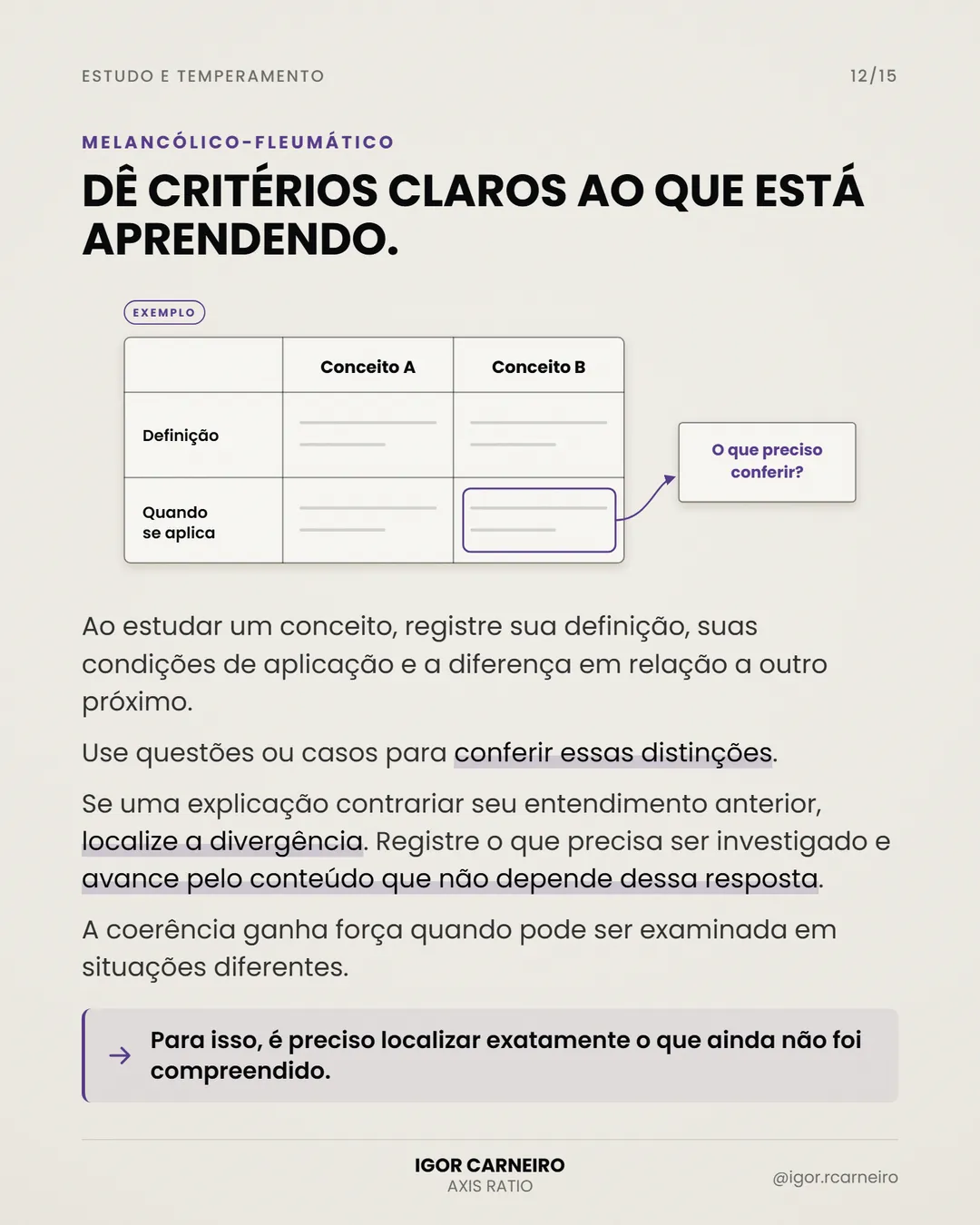
GIVE CLEAR CRITERIA TO WHAT YOU ARE LEARNING.
MELANCHOLIC-PHLEGMATIC
When studying a concept, write down its definition, the conditions under which it applies, and how it differs from a related one.
Use questions or cases to check these distinctions.
If an explanation contradicts your previous understanding, pinpoint the disagreement. Note what needs to be investigated and move on through the material that does not depend on that answer.
Coherence gains strength when it can be examined in different situations.
For that, you need to pinpoint exactly what has not yet been understood.
 13
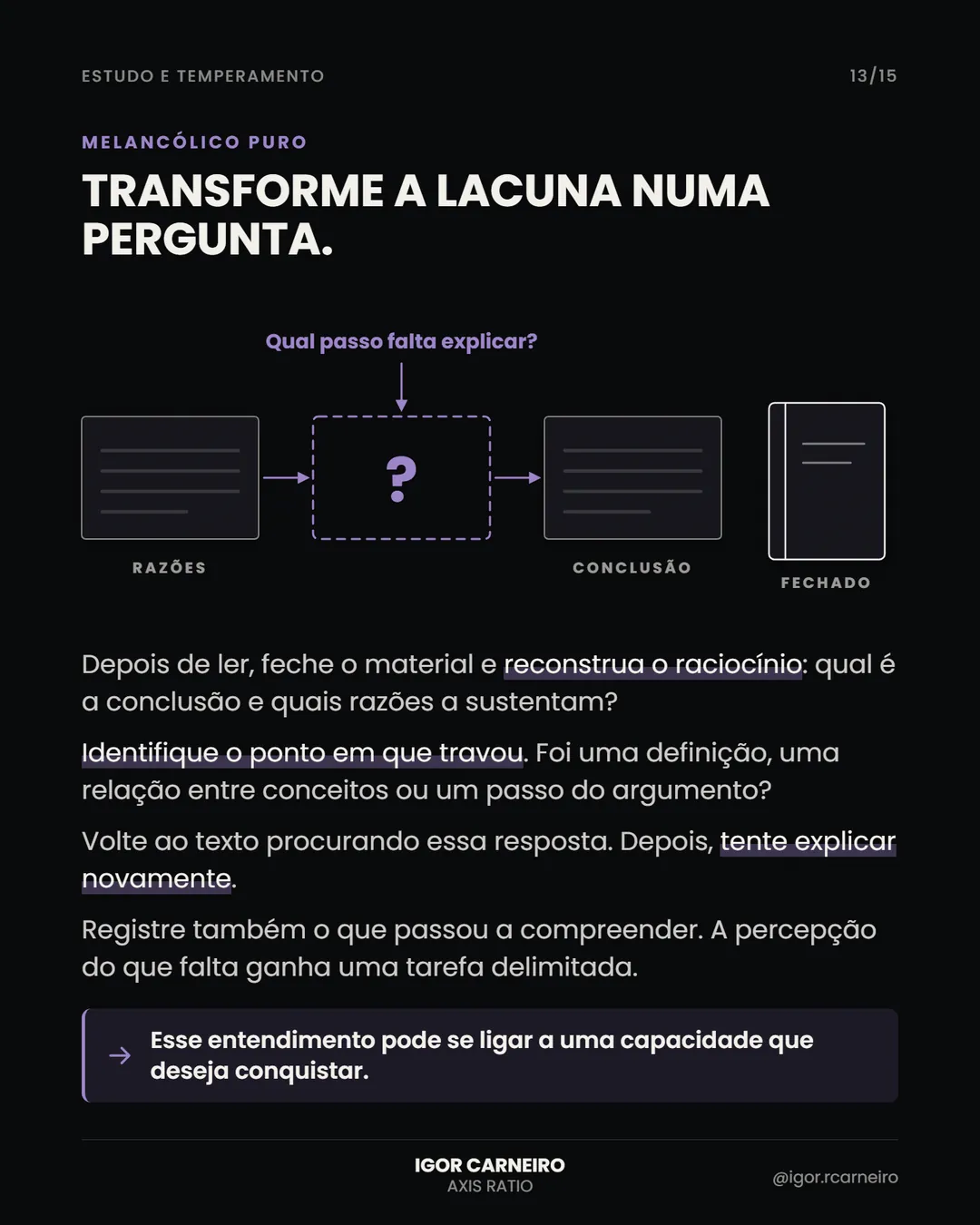
TURN THE GAP INTO A QUESTION.
PURE MELANCHOLIC
After reading, close the material and reconstruct the reasoning: what is the conclusion and what reasons support it?
Identify the point where you got stuck. Was it a definition, a relationship between concepts, or a step in the argument?
Go back to the text looking for that answer. Then try to explain it again.
Also write down what you have come to understand. Your sense of what is missing gets a well-defined task.
This understanding can be tied to a capability you want to gain.
 14
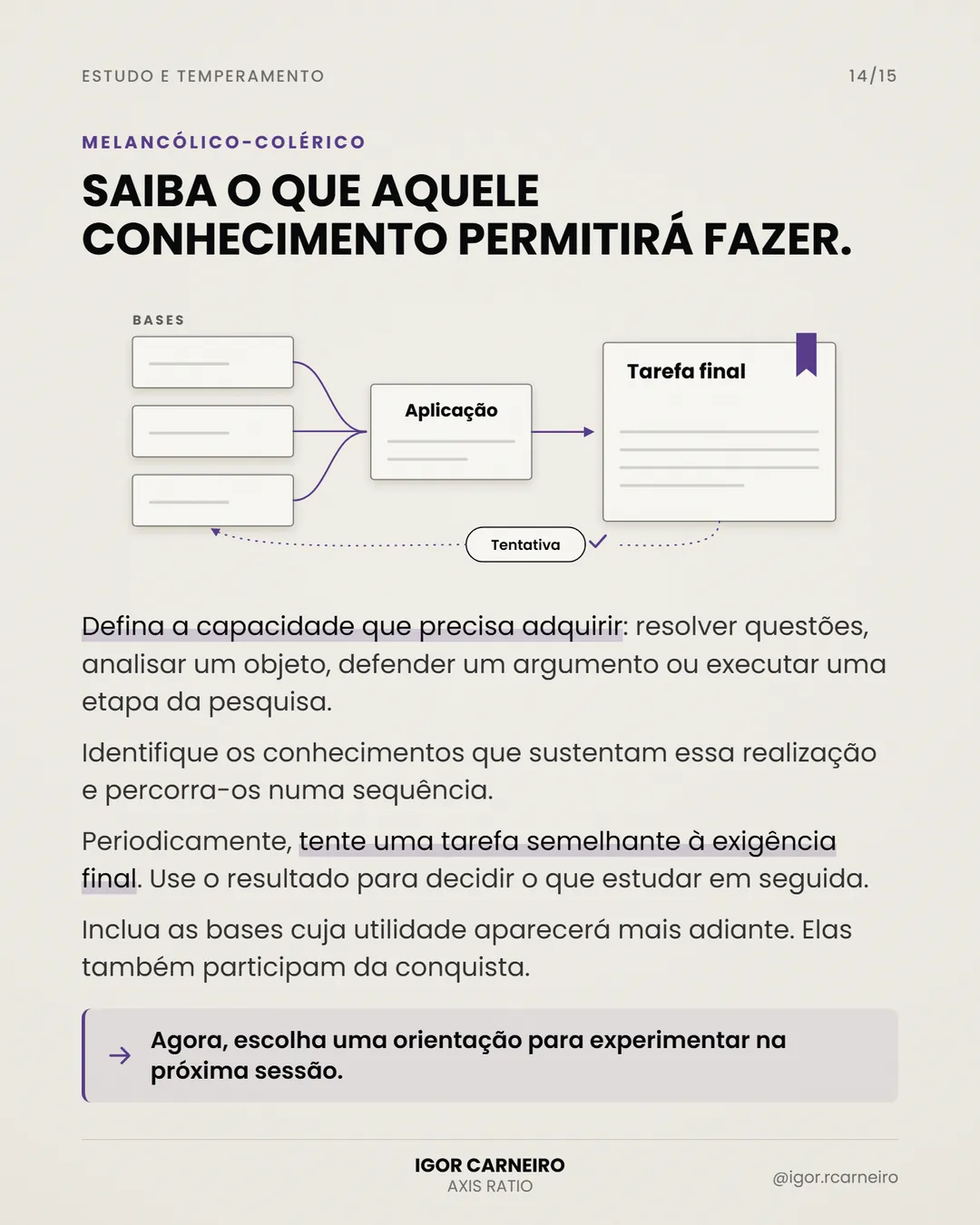
KNOW WHAT THAT KNOWLEDGE WILL LET YOU DO.
MELANCHOLIC-CHOLERIC
Define the capability you need to acquire: solving questions, analyzing an object, defending an argument, or carrying out a stage of the research.
Identify the knowledge that supports that accomplishment and work through it in sequence.
Periodically, attempt a task similar to the final requirement. Use the result to decide what to study next.
Include the foundations whose usefulness will only show up later. They are also part of the conquest.
Now, choose one piece of guidance to try in your next session.
 15
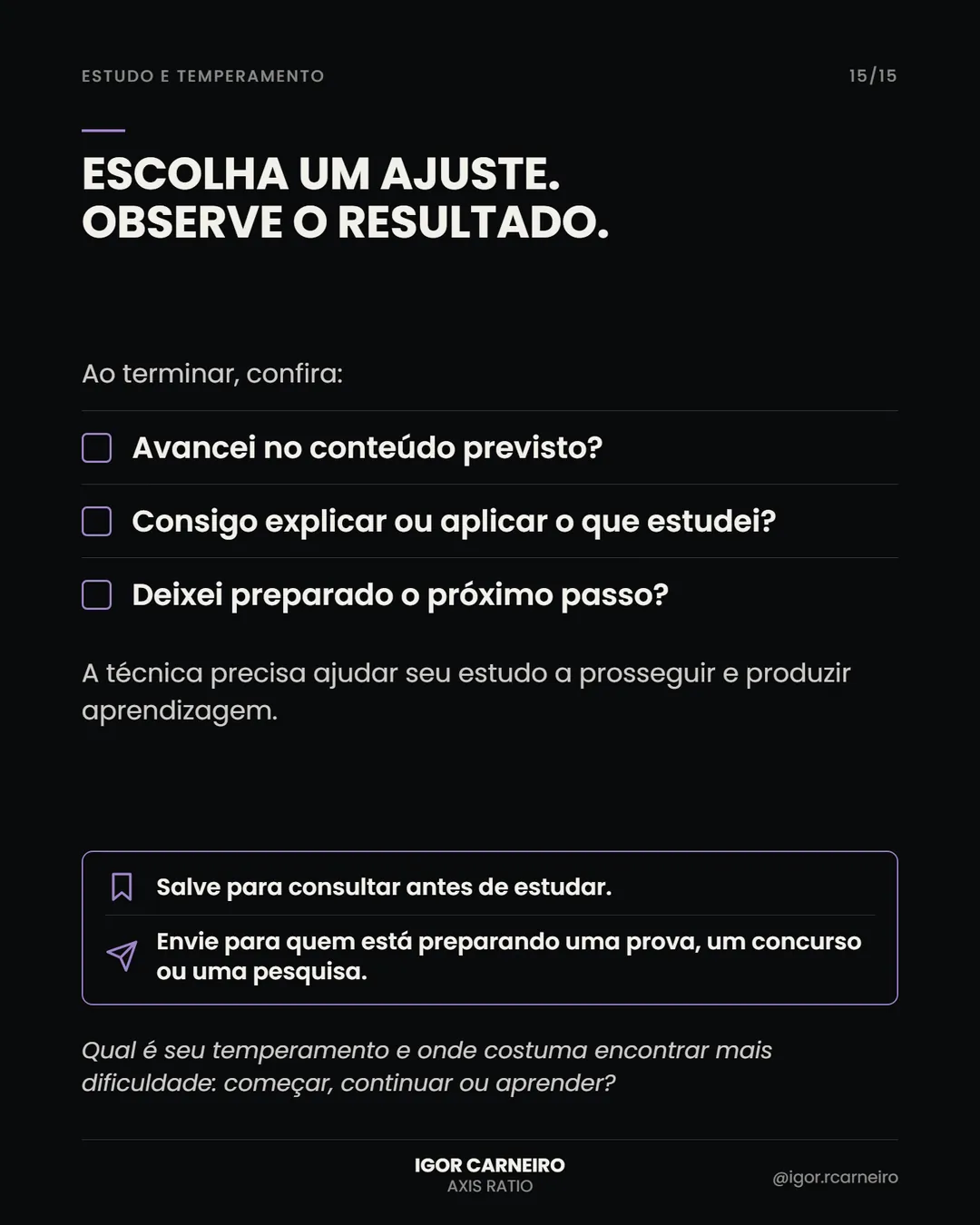
CHOOSE ONE ADJUSTMENT. OBSERVE THE RESULT.
When you finish, check:
Did I get through the planned material?
Can I explain or apply what I studied?
Did I leave the next step ready?
The technique needs to help your study move forward and produce learning.